
White Glove Genealogy
Menu

Genealogy research by surname line · Europe, the Americas and the British Isles

The ancestor you can’t find, found or fully accounted for.

Pick a surname, and our research engine follows that line back through the parish books, civil registers and court files that searches miss, in Latin, French, Dutch, German and more. Every ancestor it finds arrives in your tree with the record behind it.

  • From $600 per surname line
  • First findings within days
  • Every source cited, every uncertain link marked
  • Follow the research live in your account
Handwritten page of the 1712 burial register of Notre-Dame-de-la-Chaussée, Valenciennes, with the name Leborne written in the margin
Burial · 11 January 1712 · ValenciennesClose-up of the entry naming Michel Leborne

“Le 11 janv 1712 fut fait l’enterrement et service au 2me estat de Michel Leborne, Blan Gand, rue des Goblets.”

On 11 January 1712, the burial and a second-class service were held for Michel Leborne, at the White Glove tavern, rue des Goblets.

Register of the dead, Notre-Dame-de-la-Chaussée, Valenciennes, 1712. Archives départementales du Nord, 5 Mi 055 R 001, image 1005.

Case file: a tavern keeper who left no trail

Michel Le Borne kept the White Glove tavern in Valenciennes and died in 1712. His son Jacques Antoine sailed to Louisiana in 1718 and founded a family on the German Coast. The Valenciennes trail went cold, because the parish books from before 1694 are lost. So we followed his eldest son to Cambrai, found where the family began, and are now working back from there.

  1. before 1694
    Parish registers lost

    Found

    The Notre-Dame-de-la-Chaussée registers before 1694 don’t survive, so Michel’s marriage and his eldest son’s baptism had to be found somewhere else.

  2. 1687
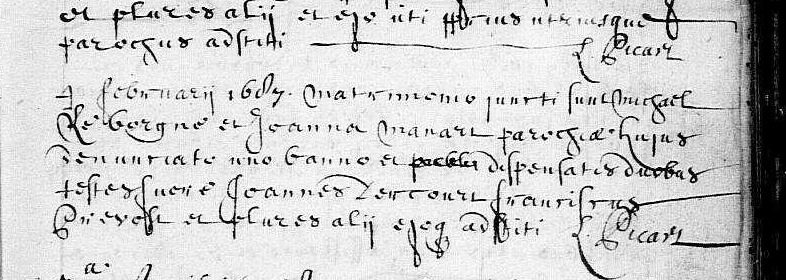
    Marriage of Michel Le Borgne and Joanna Manart, Cambrai

    Found

    Latin marriage entry of Michael Le borgne and Joanna Manart, 4 February 1687matrimonio juncti sunt Michael Le borgne et Joanna Manart parochiae hujus

    Married at St-Martin, Cambrai, on 4 February 1687, “of this parish”. The Valenciennes clerks never recorded it because the family hadn’t moved there yet.

    AD Nord 5 Mi 012 R 021, folio 65

  3. 1687
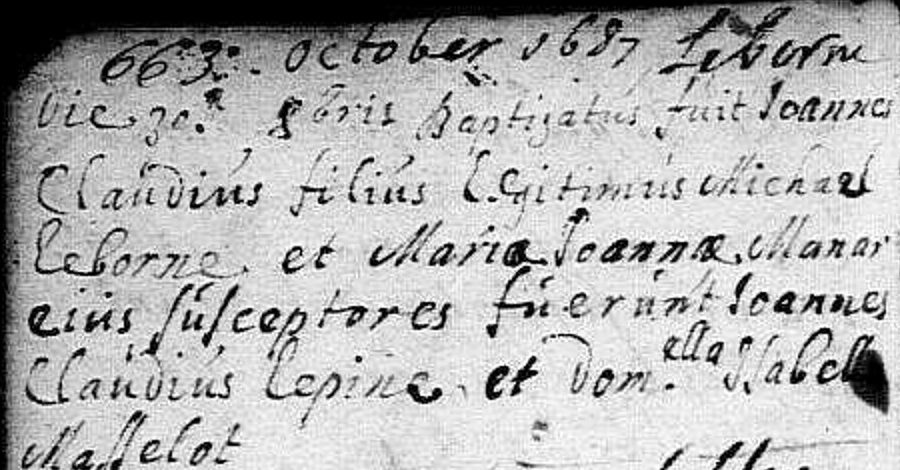
    Baptism of their son Jean Claude, Cambrai

    Found

    Latin baptism entry of Joannes Claudius, son of Michael Leborne and Maria Joanna Manar, 30 October 1687Joannes Claudius filius legitimus Michaelis Leborne et Mariae Joannae Manar

    Baptized at St-Nicolas, Cambrai, on 30 October 1687. This settles a puzzle: Jean Claude was Marie Jeanne Manart’s son, so there was no “unknown first wife”.

    AD Nord 5 Mi 012 R 025, folio 663

  4. 1712
    Burial of Michel

    Found

    No age, no parents named. Eleven months later his widow still occupies the house “bearing the sign of the Gant Blanc” in the rue des Goblets.

    AD Nord 5 Mi 055 R 001, image 1005; Fonds Caffiaux, cote 3822

  5. 1718
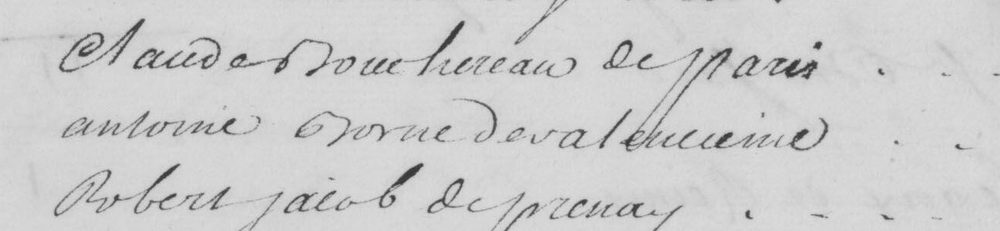
    Jacques Antoine sails for Louisiana: “antoine Borne de valencienne”

    Found

    Passenger roll line reading antoine Borne de valencienneantoine Borne de valencienne

    The passenger roll of La Marie, La Rochelle, 23 May 1718, lists him by name and town. This is the record that ties the Louisiana family to Valenciennes.

    ANOM, COL F5 B 57, view 16

  6. 1747
    Jean Claude, master brewer of Cambrai, buried “aged 60”

    Found

    Died December 1747 at sixty: an exact match with the 1687 baptism, tying the Cambrai brewer to Michel’s eldest son.

    Cambrai burials 1747, p. 230 (St-Fiacre)

  7. Now
    Searching: Michel’s own baptism and parents in the Cambrai registers

    Research ongoing…

    Reading the Cambrai parish books page by page for the 1650s and 1660s, and following the godmother Maria Le Borgne.

Read the full case

Research log · Michel Le BorneResearch ongoing

Last updated · 1,046 register images read · 45 searches logged

Research questionWhere was Michel Le Borne born, and who were his parents? He married at Cambrai in 1687, so probably born about 1655–1667.
  1. RegisterCambrai La Madeleine baptisms, 1630–1650Reading page by page for Michel’s own baptism and his parents.In progress
  2. RegisterPassenger roll of La Marie, La Rochelle, 1718“antoine Borne de valencienne” sailing for Louisiana, 23 May 1718: ties the Louisiana family to Valenciennes.ANOM, COL F5 B 57, view 16Found
  3. RegisterCambrai La Madeleine baptisms, 1659–1679Marie Jenne Manart, baptized 30 Aug 1665, daughter of Hierosme Manart and Barbe Douchet: probably Michel’s wife. Not yet proven.AD Nord, Cambrai La Madeleine, ark 6h5nkmx34zfd, img 801[?] Lead
  4. RegisterCambrai La Madeleine baptisms, 1659–1679Read page by page: no baptism of a Michel Le Borgne or Le Borne. A few faint pages can’t be fully excluded.AD Nord, ark 6h5nkmx34zfd, imgs 776–849Not found
  5. RegisterCambrai La Madeleine baptisms, 1646–1659Read page by page: no baptism of a Michel Le Borgne or Le Borne.AD Nord, ark 6h5nkmx34zfd, imgs 700–775Not found
  6. RegisterCambrai La Madeleine baptism table, Michel entriesBoth indexed Michel baptisms dated: 1641 and 1679. Neither is ours; they belong to the other Cambrai Michel’s family.AD Nord, ark 6h5nkmx34zfd, imgs 219 and 576Not found
  7. RegisterCambrai La Madeleine baptisms, 1641Household of Michel Leborne × Jeanne Fi[?]lle (1640s) could include a younger son Michel. Best lead for his parents.AD Nord, ark 6h5nkmx34zfd, img 219[?] Lead
  8. RegisterCambrai La Madeleine burials, 1689–1727Michel × Anne Le Clerc was buried at Cambrai in 1720 aged 80. Ours died in 1712, so they are two different men.Not found
Every empty search is logged, so nobody pays to repeat it. This is the format every client receives.View full log (46 entries)
Handwritten marriage entry from January 1697 in the Notre-Dame-de-la-Chaussée register

What the work looks like

“Le seize janvier 1697 furent fiancés Robert François Alardin de la paroisse de St Géry et Marie Claire Marlier de cette paroisse…”

Most answers sit in pages like this one: no index, period spelling, a clerk’s hurried hand. We read them line by line, in the original language, until the answer turns up or the record runs out.

Marriages, Notre-Dame-de-la-Chaussée, January 1697. AD Nord, 5 Mi 055 R 001, image 163.

Genealogy research without the six-month wait

Our research engine does the slow part of genealogy: reading thousands of handwritten register pages in the original languages, checking every spelling, and logging every search. It shows its work, so you pay for answers instead of hours.

Typical research firmWhite Glove
PriceAbout $3,200 for a 25-hour package$600 per surname line, $1,500 for a full line
Turnaround4–6 months is commonFirst findings within days. Most lines complete in 2–6 weeks
What you seeA final reportEvery search, live, in your account
Unindexed recordsRead by hand, billed by the hourRead in full, at no extra cost
If the records run outHours used, ask for moreA documented brick wall, and nothing more to pay

Typical-firm figures reflect published package pricing and timelines from established U.S. research firms, 2026.

If a full line ends early, $900 comes back.

Some records simply don’t survive. If a full-line search reaches a brick wall within the first 200 years, we refund $900 of the $1,500 and show you exactly where and why the line stops.

See pricing

How it works

Everything happens in your account. You see the price before you pay, and every search as it happens.

  1. Create a free account

    Your tree, your orders and every finding live there, and you can come back any time.

  2. Add your tree

    Upload a GEDCOM from Ancestry, FamilySearch or MyHeritage, or type in what you know. Three generations is enough.

  3. Pick surname lines

    We list every surname in your tree with its starting ancestor and an exact price. Choose one line or several.

  4. Watch it grow

    First findings within days, and most lines complete in 2–6 weeks. Each ancestor arrives in your tree with sources, record images and a confidence label.

Pricing

A surname line starts at the earliest ancestor you know with that name and follows the line father to father, back in time. Wives and mothers are recorded on every generation; their own surnames are separate lines. First findings within days. Most lines complete in 2–6 weeks.

Start here

Not sure which to choose? Three quick questions.

Do you want to go as far back as the records allow?
Do you want us to keep watching for new records?
Are you researching one family name or your whole family?

We’d suggest: Full line. Most people start here: one surname as far back as the records go, with $900 back if it ends early. See it below

Surname line

$600per line

Up to 200 years back from your starting ancestor.

  • About 7 generations searched
  • +$100 per extra 100 years, only if records go further and only up to the limit you set
  • Records end sooner? You get the documented brick wall and pay nothing more
Choose a line
Most people start here

Full line

$1,500per line

One surname line, as far back as the records go.

  • Most lines reach 1550–1700
  • Searched until the records run out or the next generation can’t be proven
  • $900 refunded if the line ends within 200 years
Choose a full line
Best value

Full line + Watch

$2,000per line

The full line, then we keep looking.

  • Everything in Full line
  • Quarterly checks for 3 years as archives put new records online
  • Any breakthrough researched until the next brick wall, at no extra cost
  • A short report every quarter showing what was checked
Choose Full line + Watch

Family

$4,000

All four of your grandparents’ lines, told as one story.

Best for: anyone who wants the whole family, not just one name.

  • Four surname lines researched in full
  • Quarterly checks for 3 years on all four
  • A generated family history and slide presentation
  • One review call to walk through the findings
Choose Family
Limited spots each month

White Glove

From $10,000after an evaluation

Every line back to your 5th great-grandparents, each taken as far as the records allow, plus full lines on up to four surnames your family cares about most.

  • Priced after we evaluate your tree and what you want covered
  • Kickoff call to plan the work
  • Final presentation by video, or in person for an added fee
  • A generated family history and presentation
  • DNA analysis where you share match data
  • Citizenship-by-descent eligibility check
  • Lineage-society eligibility check
  • Quarterly updates for 3 years, with breakthroughs researched
  • Then $750 to $1,000 a year to keep watching

Pay over time with Affirm (subject to approval), or in three stages: 40% to start, 30% at the midpoint review, 30% on delivery.

Begin with a conversation

What you receive

Work you can check, keep and build on, whether the answer is yes, no or not yet.

Your tree
New ancestors, added as they’re foundEach with dates, places, family links and a confidence label.
Records
Images of the key recordsWith transcriptions and English translations, attached to each person.
Tree file
A sourced GEDCOM downloadImport it into Ancestry, FamilySearch, MyHeritage or your own software.
Search log
Every source we checkedIncluding the empty ones, so nobody repeats the work.
Next steps
A plan for what’s leftWhich records remain, where they are, and what they might show.
Presentation
Your family’s story, ready to shareA generated history and slides, included with Family and White Glove.

See exactly what you’ll get

Read a complete sample report before you spend a dollar: the evidence, the translations, the search log and the open questions, just as a client receives it. It’s the real Michel Le Borne case.

Read the sample report

How we research

If a link in your tree isn’t proven, we say so. You’ll see it marked [?], with the evidence for and against.

Primary sources firstConclusions rest on original records, not on other people’s online trees.
Every conclusion shows its workEach link in your tree points to the record that supports it, so you or anyone else can check it.
Uncertainty is labeledProven, probable and open are marked as such, every time.
We tell you when to stopWhen the records run out, we say so, show what was searched, and charge nothing more.
Accuracy you can check
AI-researched to the Genealogical Proof Standard.

Our research engine reads handwritten records in their original language. Every transcription is shown next to an image of the original page, readings we’re unsure of are marked [?], and every conclusion cites the record behind it, so you, or any genealogist, can check our work line by line.

Hanging tavern sign reading Au Gant Blanc, Rue des Goblets, Valenciennes, with a white glove
About us

Why we’re called White Glove

In the early 1700s, a tavern keeper named Michel Le Borne ran a cabaret in Valenciennes, in northern France, under the sign of the White Glove: au Gant Blanc, rue des Goblets.

We found him the way we find everyone: one handwritten line at a time. The parish clerk who buried his wife in 1707 wrote “au blan gand rue des gobletz.” When Michel was buried in January 1712, the clerk wrote “Blan Gand” again. His son Jacques Antoine had already grown up in that tavern. In 1718 he sailed from La Rochelle to Louisiana and started a family that is still there three hundred years later.

Our founder descends from that family. Tracing Michel back through French and Belgian archives, register by register, is the work that started this company, and it’s still going: in 2026 the trail led from Valenciennes to Cambrai, where Michel married and his first children were baptized. We named the company after his tavern because that sign is where our own story begins, and because “white glove” already means what we promise: careful, patient handling of something irreplaceable.

Why we do this

Every family has someone who disappears from the record: an immigrant who never said where he came from, a grandmother whose maiden name nobody wrote down, a line that stops cold in 1850. Those gaps don’t mean the answer is gone. Usually it’s sitting in a register nobody has read yet, in a language the family no longer speaks.

We love the moment a name turns up in the margin of a three-hundred-year-old page. We love it just as much when we can show a family exactly where the records end and why. Either way, you get the truth about your people, with the evidence to back it up.

A note for the archivists: we don’t actually wear white gloves to handle old paper. Clean, dry hands are better for it. The gloves are about how we treat your family’s story.

Questions about genealogy research

If yours isn’t here, ask it in the form. See all questions.

How much does genealogy research cost?

Independent genealogists usually charge by the hour, and established firms sell packages starting around $3,200. White Glove Genealogy charges by surname line: $600 for up to 200 years, $1,500 for a full line as far back as the records go, and $2,000 for a full line with three years of quarterly checks. Family ($4,000) and White Glove (from $10,000, priced after an evaluation) cover many lines at once.

How long does it take?

First findings within days. Most lines complete in 2–6 weeks. Lines that run through unindexed registers in several archives take longer, and you can follow every search in your account as it happens.

What is a surname line?

One family name, followed back in time from father to father, starting at the earliest ancestor you already know with that name. Spelling changes are followed too: Le Borne, Leborne and Le Borgne are one line. Each wife’s and mother’s own surname is a separate line.

How far back can you go?

It depends on where your family lived. English parish registers start in 1538 and many French, Italian and Spanish records in the late 1500s or 1600s. Irish Catholic registers often begin only around 1800–1830, and Eastern European records are patchier. Most lines reach somewhere between 1550 and 1700.

What if a line ends early?

You get the full search log, an explanation of what the records show and don’t show, and a plan for what remains. A $600 line costs nothing more. On a $1,500 full line, we refund $900 if the line ends within the first 200 years.

Is the research done by AI?

Yes. Our research engine reads and transcribes handwritten records, compares candidates and writes up its conclusions following the Genealogical Proof Standard. Every transcription is shown next to an image of the original page, readings we’re unsure of are marked [?], and every conclusion cites the record behind it, so you, or any genealogist, can check our work line by line.

Which countries do you cover?

Most of Europe, the Americas and the British Isles, wherever surviving records can be reached online. Each line shows what to expect before you order.

Start here

Upload your tree, free

Create an account, add your tree and see a price for every surname line. You only pay when you choose a line.

Create a free account

Interested in White Glove? Tell us about your family and we’ll set up a call.

No payment now. Financing available through Affirm.