
Blog ·
Is everyone really descended from Charlemagne?
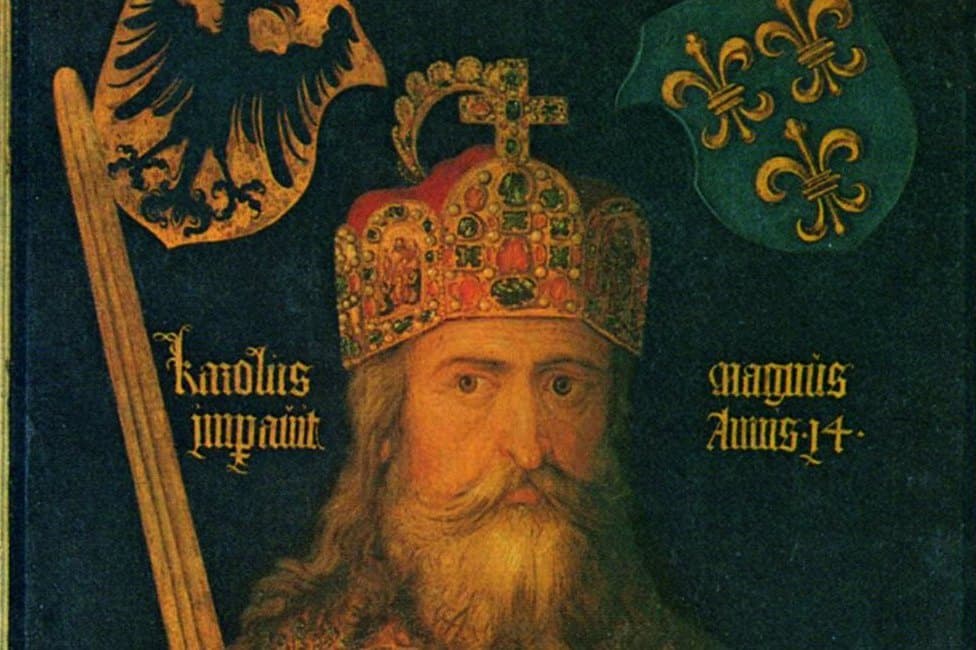
You have probably heard the claim at a dinner party or seen it in a comment thread: every person of European descent is a descendant of Charlemagne. It sounds like the kind of thing that cannot possibly be true, or that is true in some trivial way that does not count. In fact it is true in the strongest sense available to genealogy, and it is worth understanding exactly why, because Charlemagne is the one place where two very different kinds of evidence, the mathematical and the documentary, finally shake hands.
The man and the numbers
Charlemagne was born around 748 and died in 814. He ruled the Franks, was crowned Emperor of the Romans in 800, and, by the count of his biographer Einhard, had at least eighteen children by several wives and concubines. His grandchildren and great-grandchildren married into every royal and ducal house of early medieval Europe. That is the only fact you need to start the argument. A man who sits at the root of every noble family in Europe by the year 1000 is a man whose descendants had an enormous head start.
Now count the generations. From 800 to today is about 1,200 years, or roughly 40 generations at a conservative 30 years per generation. Your number of ancestral slots 40 generations back is 2 to the 40th power, which is just over a trillion. The entire population of Europe around the year 800 was perhaps 25 to 30 million. So your trillion slots are filled by at most 30 million people, each appearing an average of tens of thousands of times.
That alone does not make Charlemagne your ancestor. It makes almost anyone of his era who left descendants your ancestor. The statistician Joseph Chang showed in 1999 that in a randomly mixing population, the most recent common ancestor of everyone alive is startlingly recent, and that a little further back there is a point where every person who left descendants at all is an ancestor of everyone. For Europe, Chang, Rohde, and Olson estimated in 2004 that this point falls somewhere around 1,000 to 1,500 years ago. Charlemagne sits right in that window.
Why he is special anyway
If the math already proves it, why does Charlemagne get the headline rather than some anonymous Frisian farmer who also left descendants? Because for Charlemagne, and almost nobody else from his century, the paper trail exists too.
Genealogists use the term gateway ancestor for a person whose descent from royalty or old nobility is documented, and who has a large number of living descendants with ordinary surnames. Charlemagne’s children and grandchildren are documented in charters and chronicles. Their descendants, the Carolingian counts and dukes, are documented through the 900s and 1000s. Those families married into the lesser nobility, whose descent is tracked in the cartularies of monasteries and the records of feudal courts. By the 1200s and 1300s the lines are flowing into the gentry, the merchant class, and the landed yeomanry, who in turn appear in the parish registers from the 1500s onward.
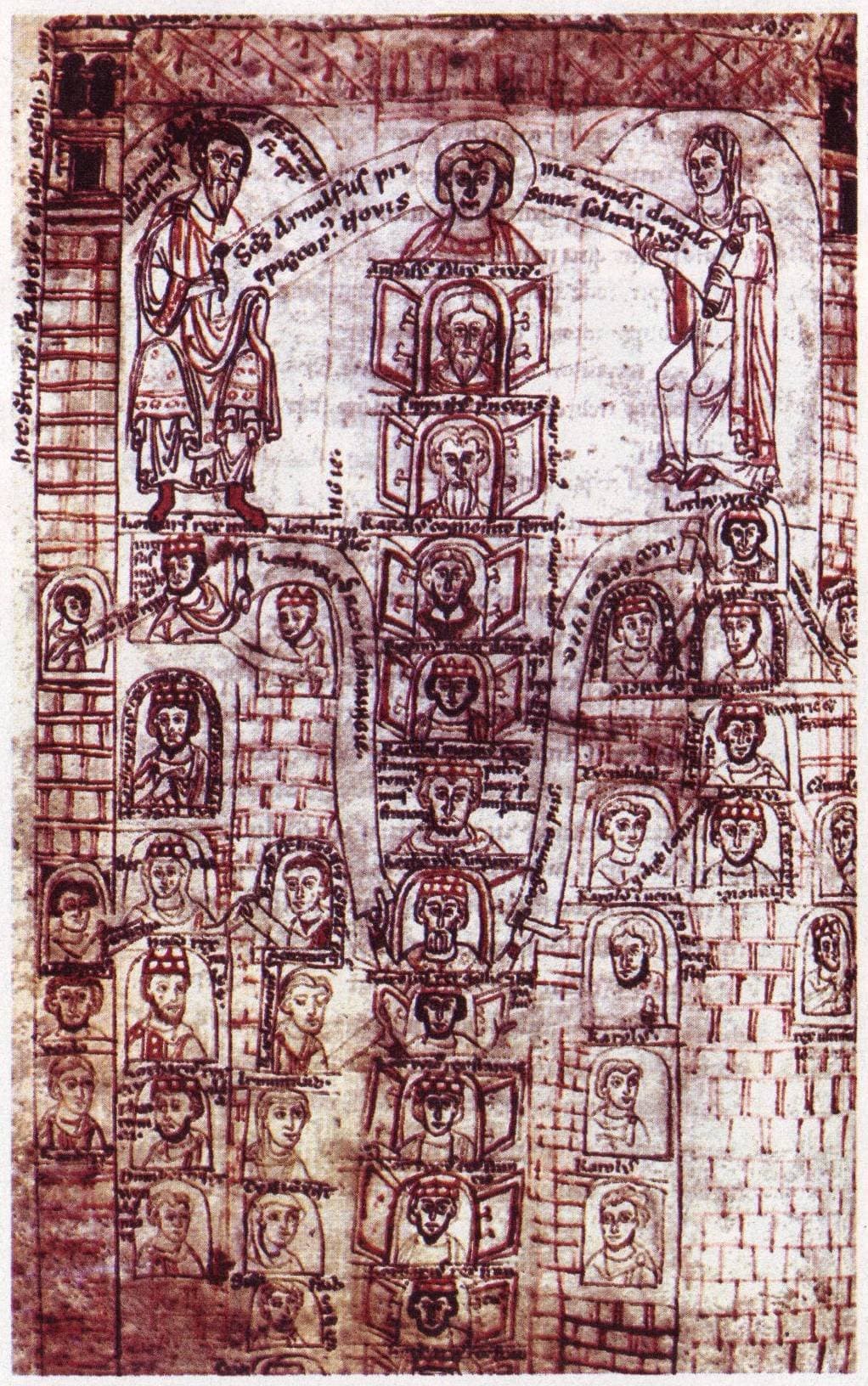
The result is that a genealogist today can often prove a descent from Charlemagne, link by link, with a document for every generation. The American Society of Genealogists and similar bodies maintain lists of gateway ancestors to the American colonies, meaning early settlers whose royal descents have been verified by professional standards. There are several hundred of them. Anyone who descends from one of those colonists, and there are tens of millions of such Americans, has a proven descent from Charlemagne.
So Charlemagne is where the two methods agree. The statistics say you descend from him. The documents, for a large fraction of people, can actually show you how.
How a gateway line actually works
It helps to see the shape of one. A typical documented descent runs from Charlemagne through his son Louis the Pious and grandson Charles the Bald, then through a daughter who married a count of Flanders or Vermandois in the 800s. From there it passes through the counts of Vermandois to the Capetian royal family, or through Flanders to the Norman dukes, and from either into the Anglo-Norman baronage after 1066. English baronial families are unusually well documented from the twelfth century because of royal inquests, feudal surveys, and the pipe rolls of the Exchequer.
By the 1400s the line has usually dropped out of the peerage into the gentry, a knight’s younger son who became a country squire. By the 1500s it is in a parish register. By the 1600s a descendant with a surname like Bulkeley, Lunsford, or Throckmorton boards a ship to Virginia or Massachusetts, and that colonist becomes the gateway. Every link in such a chain has been argued over in journals like The American Genealogist and Foundations, and the accepted ones have survived that argument. Douglas Richardson’s Royal Ancestry and Gary Boyd Roberts’s The Royal Descents of 900 Immigrants are the standard compilations, and they are revised as links are confirmed or broken.
The honest caveats
Three things need saying before anyone orders a coat of arms.
First, the mathematical claim applies to people with ancestry in the connected European population. Someone whose ancestry is entirely East Asian or sub-Saharan African before 1500 is not covered by the European model, although global common ancestry at a somewhat deeper date is just as certain. For most people with any European ancestor, even one, the conclusion holds, because a single line into Europe is enough to inherit all of Europe’s collapsed ancestry.
Second, “descended from” is not the same as “carrying DNA from.” Autosomal DNA halves with each generation and after roughly seven or eight generations most individual ancestors contribute no detectable segment. At 40 generations the odds that you carry any Charlemagne DNA at all are small. He is in your pedigree, not in your genome.
Third, a documented descent is a documented descent through one path. The math says you probably descend from Charlemagne through millions of paths. The genealogist’s achievement is to find a single one of them that the records happen to illuminate. That is impressive, and it is also a reminder of how much is dark.
What this does to the hobby
Some people find this deflating. If everyone descends from Charlemagne, what is the point of proving it? That gets the value backwards. The claim “I descend from Charlemagne” is indeed worthless as a distinction, because it distinguishes you from no one. The claim “here is the chain of documents by which I descend from Charlemagne” is a different thing entirely. It is a piece of verified history, and each of its forty links is a real person with a real name who lived in a real place. The nobleman in the 1300s who lost his lands in a feud, the widow in the 1600s who remarried a tanner, the emigrant in the 1700s who crossed the Atlantic with nothing: those are the story, and Charlemagne is just the anchor at the far end.
So the next time someone tells you they are descended from Charlemagne, the right response is not “so is everyone.” The right response is “show me the links.” If they can, you are looking at genuine genealogy. If they cannot, you are looking at arithmetic, which is also true, but not the same thing.
Sources
- Chang, J. T. (1999). “Recent common ancestors of all present-day individuals.” Advances in Applied Probability 31(4): 1002–1026.
- Rohde, D. L. T., Olson, S., and Chang, J. T. (2004). “Modelling the recent common ancestry of all living humans.” Nature 431: 562–566.
- ScienceDaily summary of Rohde et al. (2004).
- Legacy Tree Genealogists, “Am I Related to Royalty? Researching Gateway Ancestors.”
- FamilySearch, “Documenting Royal Ancestry.”
- Coop, G. (2013). “How many genetic ancestors do I have?” gcbias.
- Richardson, D. Royal Ancestry: A Study in Colonial and Medieval Families (2013). Roberts, G. B. The Royal Descents of 900 Immigrants (2018). Print references.
Image credits
- Albrecht Dürer, Emperor Charlemagne (c. 1511–13), Germanisches Nationalmuseum, Nuremberg (detail). Wikimedia Commons (The Yorck Project), Public domain.
- Carolingian family tree, Chronicon universale of Ekkehard of Aura. Wikimedia Commons, Public domain.

