
Blog ·
Proof by elimination: finding Marie Jeanne Manart’s parents
Marie Jeanne Manart is the mother of the man who went to Louisiana. Her marriage in 1687 names no parents. Her burial in 1707 names no parents. No record we have found says whose daughter she was. So this post is about the other kind of evidence, the indirect kind, and about how far it can carry you before you have to stop and say “probable”.
Start by throwing out the dates
The tree I inherited gave her birth as 1688. She married in February 1687, so that is impossible, and it is the kind of impossibility that a tree never notices on its own. The tree’s later guess, “about 1673”, came from a candidate baptism that has since been withdrawn. What we actually know is this: she married Michel LeBorne at St-Martin, Cambrai, on 4 February 1687, as “Joanna Manart parochiae hujus”, of this parish. A bride of 1687 was born before about 1667. Everything else has to be built from there.
The withdrawn candidate
The first candidate was a Marie Jenne Menart baptized at St-Géry in Valenciennes on 10 November 1673, daughter of Nicolas Menart and Jenne Sellier. It fitted an earlier version of the story, in which Michel married around 1693 in Valenciennes and the first child came in 1694. Once the 1687 Cambrai marriage was found, a girl of thirteen was no longer a bride, and the candidate went. Her record is kept in the files, marked REJECTED, as the record of a different person, because she was real and somebody else may be looking for her.
Elimination
If no record names her parents, the next question is how many women of her name and age existed in Cambrai at all. On 4 October 2026 every Jeanne or Marie Jeanne Manart in the surviving Cambrai registers, and in all fifteen parish tables, was placed.
| Candidate | Record | Verdict |
|---|---|---|
| Maria Joanna Menart, bp. 8 May 1637, St-Martin | Daughter of Grégoire Manart × Jeanne De Chy | Too old: fifty at the 1687 wedding |
| Jeanne Manar × Antoine Barbé | Married St-Nicolas 1663; buried St-Nicolas 25 Apr 1700 | Another man’s wife, and buried seven years before ours |
| Jeanne Barbe Manar, bp. 1727 | Métropole parish | Forty years too late |
| Marie Jenne, bp. 30 Aug 1665, La Madeleine | Daughter of Hierosme (Jérôme) Manart × Barbe Douchet, m. St-Georges 28 Jun 1657 | The only one who fits |
One survivor. Marie Jenne, baptized at La Madeleine on 30 August 1665, would have been twenty-one at her wedding, which is exactly what a first marriage in that time and place looks like. Her parents, Hierosme Manart and Barbe Douchet, had married at St-Georges in June 1657 and baptized eight children at La Madeleine between 1659 and 1674. Hierosme in turn was a son of Jacques Manar, which the registers prove through the 1650 marriage of his sister Catherine, where “Jacques Manar père de ladite et Jérosme Manar son frère” stood as witnesses.
The family fits
Elimination says she is the only candidate. Correlation says the candidate’s family behaves like hers.
Hierosme and Barbe had a daughter Marie Anne, baptized in 1663, who married Jean Claude Lespine at St-Georges in February 1683. Jean Claude Lespine was godfather to Marie Jeanne’s first two children at St-Nicolas, in 1687 and 1689. In 1695 a “Michael Le borne” was godfather to a Lespine child at St-Martin. Godparents in this period were drawn from close family far more often than not, and an uncle by marriage at the font twice over is the sort of link that a sister would produce. It is also exactly what you would expect if Marie Jeanne had no Manart brother in the city to ask instead.
Then there is the naming. Hierosme is not a common name. Marie Jeanne’s probable brother Géry Manart, baptized in 1661, had a son on 15 April 1692 whom he called Pierre Hyérosme. That was found on 17 October 2026, and it is the grandfather’s unusual name turning up in the next generation, which is what families did. It is supporting evidence. It is not proof, and I want to be clear about that, because naming patterns are the point at which indirect evidence most often gets inflated into something it is not. A Hyérosme in 1692 shows that Géry was Hierosme’s son. It shows nothing directly about Marie Jeanne.
What elimination cannot do
An elimination is only as good as its coverage, so here is the coverage. Cambrai’s baptism registers survive unevenly, and the previous post lists the gaps: St-Georges before 1680, Ste-Elisabeth, St-Louis, St-Waast after 1660, a lost La Madeleine volume. A Jeanne Manart baptized in any of those is invisible to us. The tables show no second Jeanne born to Hierosme after 1665, which closes one door, but not the doors that were never built.
There is a second limit. We cannot show that the child of 1665 lived. Burials for La Madeleine do not survive before 1689, nor for St-Nicolas before 1694, nor for St-Martin between 1646 and 1702. If Marie Jenne Manart died at three and her parents never reused the name, the register that would tell us is gone, and the woman who married Michel in 1687 could be a Manart from a parish with no surviving books. The elimination makes that unlikely. It cannot make it impossible.
The test that could settle it
What would prove her parentage is a record that names her as their daughter: a guardianship, a division of Hierosme’s estate, or her own marriage contract. Michel and Marie Jeanne’s contract of 1687 would have been the obvious one. It does not survive; the index of the Cambrai notaries’ contracts at the departmental archives does not list it, and the Cambrésis genealogical society’s president put it plainly in October: contracts not in the index are not held and were probably lost.
The same index does list a contract for Hierosme Manart × Barbe Douchet, 27 June 1657, the day before their church wedding, and a copy has been ordered. It should name both sets of parents and take the Manart line back a generation. What it cannot do is name Marie Jeanne, who was not born for another eight years. That is worth saying before the document arrives, so that nobody, including me, reads more into it than it can carry.
Why the label matters
Our rating for Hierosme Manart and Barbe Douchet as Marie Jeanne’s parents is probable: a strong candidate, not proven. In the working tree they are attached with that label, and the label is the whole point. A tree that cannot distinguish “the only candidate in the surviving records” from “named in the record” will eventually treat the two the same, and the next person to copy it will not know there was ever a difference.
Indirect evidence is real evidence. The Genealogical Proof Standard allows a conclusion built on it, provided the search was reasonably exhaustive, the evidence correlates, and the conflicts are resolved. Here the search is exhaustive for what survives, the evidence correlates, and there is no conflict. What is missing is the statement, and I would rather wait for the statement, or say honestly that it may never come, than promote a good inference to a fact because it has been sitting in the file long enough to feel like one. That is the difference between a lead and a finding, and the whole of this series is about keeping it.
What the papers prove
- Marie Jeanne Manart married Michel LeBorne at St-Martin, Cambrai, on 4 February 1687, and was buried at Valenciennes on 12 April 1707.
- A Marie Jenne Manart was baptized at La Madeleine, Cambrai, on 30 August 1665, daughter of Hierosme Manart and Barbe Douchet.
- Every other Jeanne or Marie Jeanne Manart in the surviving Cambrai records is ruled out for a stated reason.
- Jean Claude Lespine, husband of Hierosme’s daughter Marie Anne, was godfather to Marie Jeanne’s children in 1687 and 1689.
- Géry Manart, Hierosme’s son, named a son Pierre Hyérosme in 1692.
What isn’t proven yet
- That the child baptized in 1665 is the woman who married in 1687.
- Therefore her parents. Hierosme Manart × Barbe Douchet: probable.
- That Marie Anne Manart (× Lespine) was her sister rather than a cousin.
Sources
- Archives départementales du Nord, Cambrai, St-Martin, marriages 1664–1702, f. 65 (4 Feb 1687); St-Nicolas, baptisms 1658–1694 (30 Oct 1687, 2 Jan 1689); La Madeleine, baptisms 1659–1674 (30 Aug 1665 and the other children of Hierosme Manart × Barbe Douchet) and 1690–1692 (Hubert and Pierre Hyérosme Manart); St-Georges, marriages (28 Jun 1657; 8 Feb 1683); St-Waast, marriages 1628–1653 (19 Jun 1650).
- Archives départementales du Nord, Valenciennes, Notre-Dame-de-la-Chaussée, burials, 12 Apr 1707 (5 Mi 055 R 001, image 773); St-Géry, baptisms, 10 Nov 1673 (the withdrawn candidate).
- Cambrai parish alphabetical tables (19th-century copies, AD Nord), Manart and Douchet entries, all fifteen parishes.
- Groupement Généalogique de l’Arrondissement de Cambrai, replies of 15 and 18 Oct 2026; Roland–Doffe index of marriage contracts, AD Nord 2 E 26, entry 2E26-137 (Manart × Douchet, 27 Jun 1657), copy requested.
- Full citations are in the research file for Marie Jeanne Manart and the research plans of 4 and 14 October 2026.
Image credits
- Gonzales Coques, The Family of Jan-Baptista Anthoine (1664), oil on canvas. Royal Collection Trust (RCIN 405339), via Wikimedia Commons, Public domain.
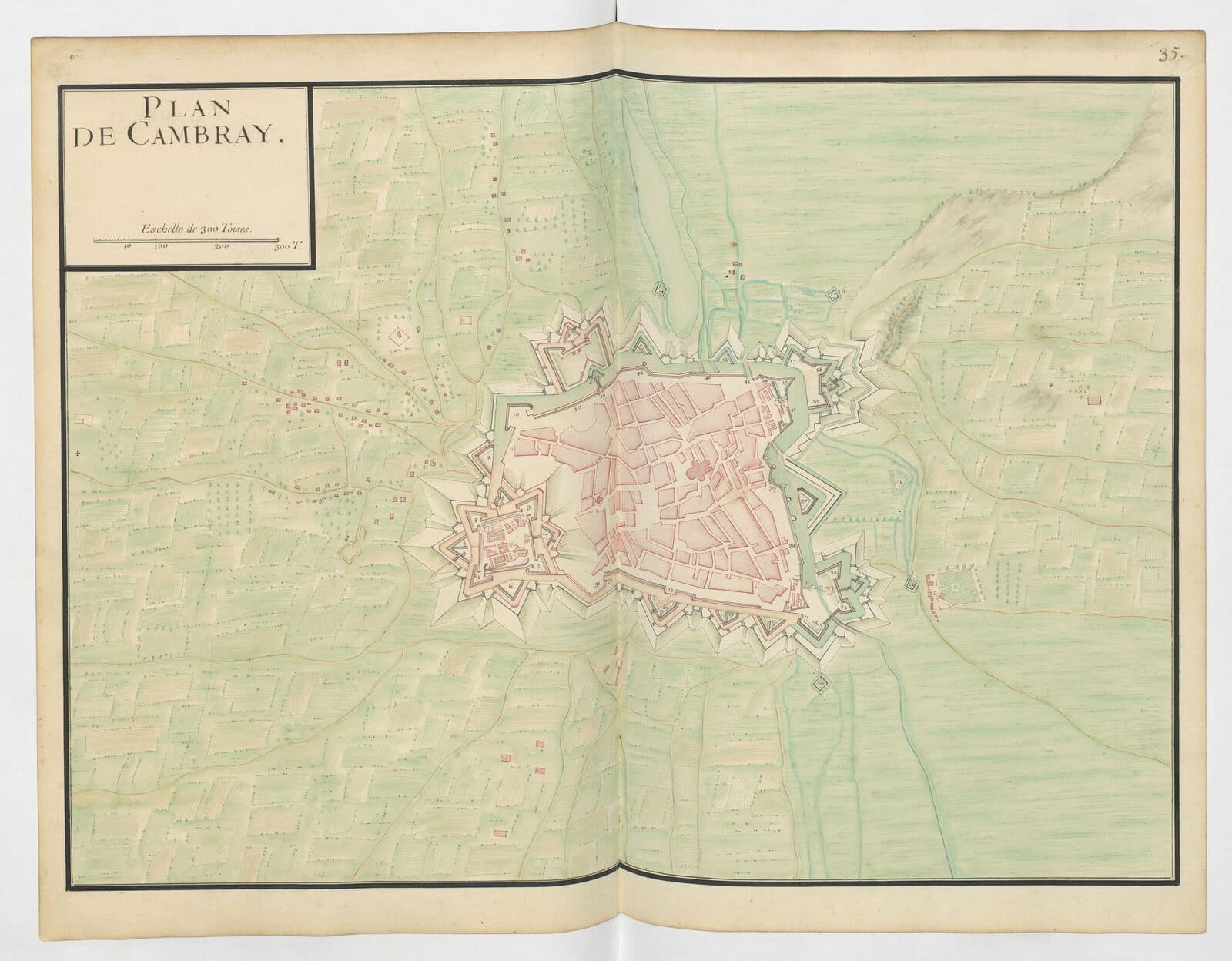
- Plan de Cambray, manuscript plan, 1693. Bibliothèque nationale de France (Gallica), via Wikimedia Commons, Public domain.
- Jan Steen, The Christening (1663). Wikimedia Commons, Public domain.