
Blog ·
The Trojan ancestor industry
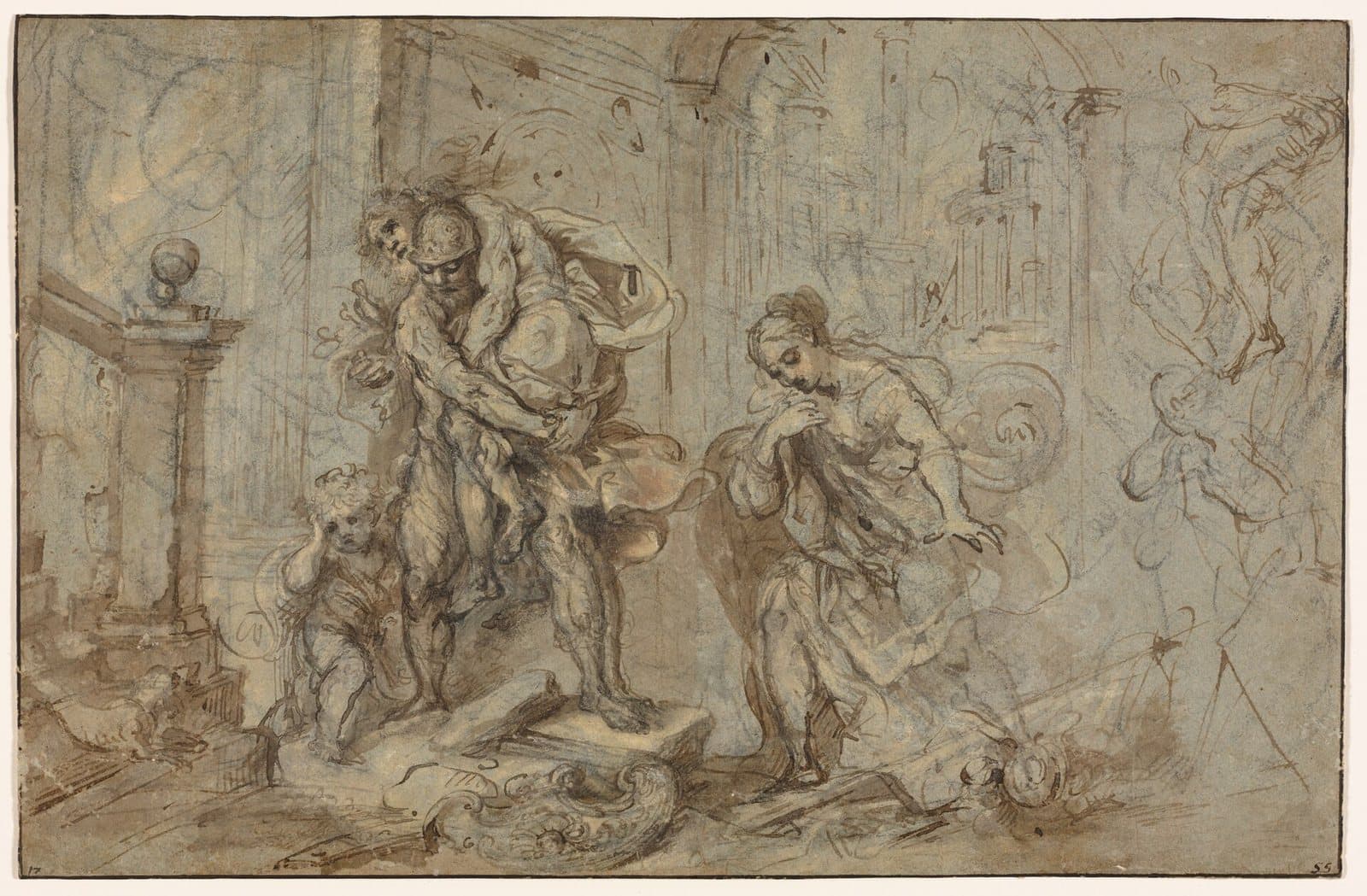
For roughly a thousand years, if you were a European nobleman and you did not descend from a Trojan refugee, a Roman senator, or an Old Testament king, you could fix that. Not by discovering new evidence, but by hiring the right scholar. Pedigree forgery was not a fringe activity or a one-off scandal. It was a service industry with recognizable products, standard prices, and repeat customers, and its output still clogs family trees today.
The Roman original
The Romans started it. Virgil’s Aeneid, commissioned under Augustus, told how the Trojan prince Aeneas fled the burning city, wandered the Mediterranean, and founded the line that would produce Romulus. The Julian family, Caesar’s family, went further and claimed descent from Aeneas’s son Iulus, which made them descendants of the goddess Venus. This was politics, not genealogy. A divine ancestor was a credential, and Augustus made sure the credential was taught in every school in the empire.
The Roman nobility imitated the Julii enthusiastically. Families acquired Greek heroes, Sabine kings, and minor gods. Cicero, who came from a provincial family with no such pedigree, made a career partly out of mocking it. But the template was set: a great house needs an ancient founder, and if the founder is not available, invent one.
The barbarian kingdoms learn the trick
When Germanic peoples settled the Western Empire, their kings had a legitimacy problem. They ruled Romans but were not Roman. The solution was to be older than Rome. The Franks, by the seventh century, had a chronicle explaining that they too descended from Trojan refugees, led by a prince named Francio, who had settled on the Danube and then moved west. The story appears in the Chronicle of Fredegar around 660 and in the Liber Historiae Francorum in 727, and it was taken seriously for eight hundred years.
The British got the same treatment from Geoffrey of Monmouth, whose History of the Kings of Britain appeared around 1136. Geoffrey supplied a founder named Brutus, a great-grandson of Aeneas, who landed in Britain and named it after himself. He then filled in a complete line of kings, including Lear and Arthur, down to the Saxon conquest. Geoffrey claimed to be translating an ancient book. No such book has ever been found and almost certainly never existed. His work became the most influential piece of invented history in the English language, and English and Welsh families attached themselves to his kings for centuries.
The Normans, the Scots, the Danes, and the Venetians all produced their own Trojan origin legends. Being Trojan was, for a while, the price of admission to serious European politics.
The Renaissance makes it professional
By the fifteenth and sixteenth centuries, the market had matured. Humanist scholars could read Latin sources, and princely courts wanted pedigrees that would survive humanist scrutiny. This created demand for a more sophisticated product: a line that began with real, attested people and bridged them to the client’s family through plausible-looking links in the dark centuries.
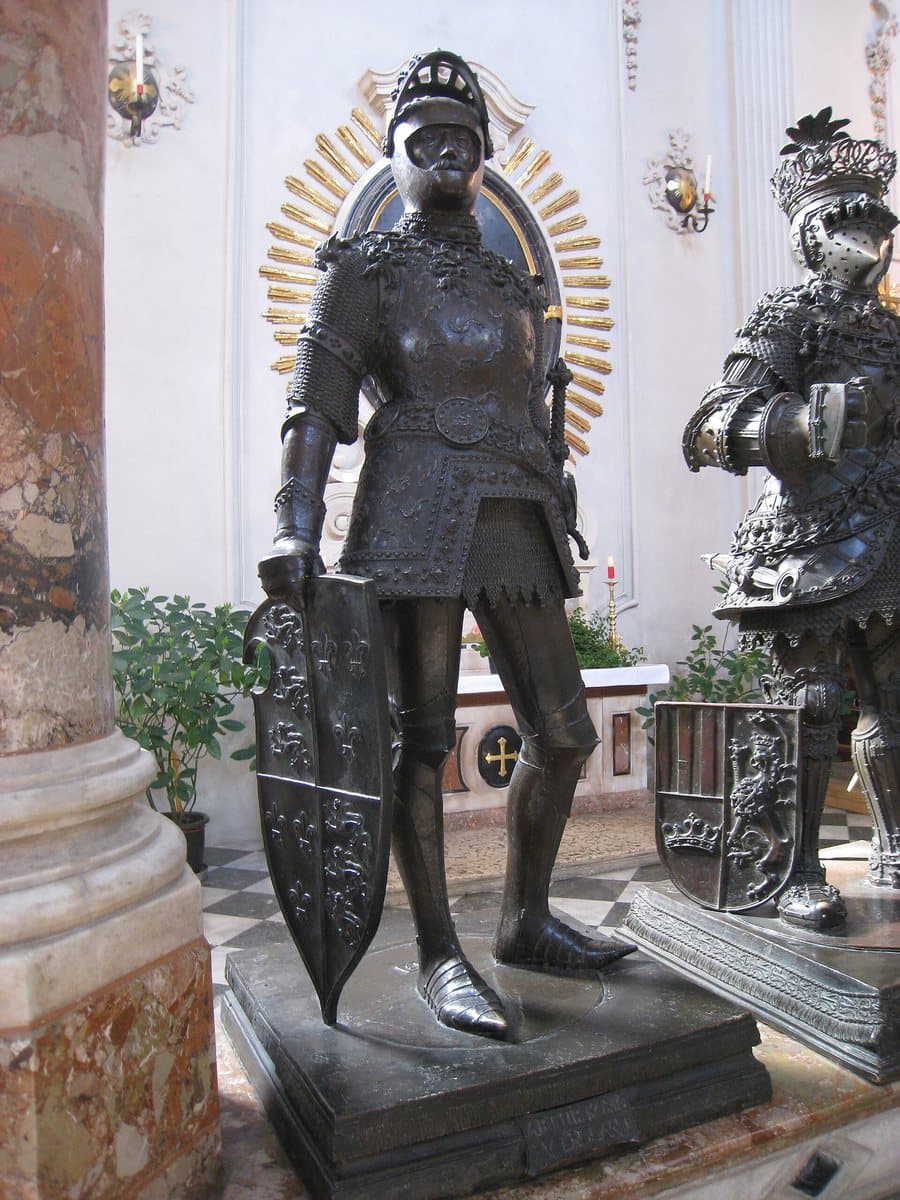
The Habsburgs are the showcase. Emperor Maximilian I, around 1500, commissioned a team of scholars to produce his ancestry. They supplied several options, including descent from the Trojans, from the Roman Julii, from the Merovingian kings, and, in one version, from Noah by way of a Roman senator named Pierleoni. Maximilian had the results carved into his monumental tomb at Innsbruck, where bronze statues of his “ancestors” include King Arthur. He knew perfectly well what he was buying. The point was not truth; the point was that a Holy Roman Emperor should have an ancestry that matched the office.
Italian families did the same on a smaller budget. The Este claimed descent from the Trojans through a Roman called Caius Actius. The Visconti traced themselves to Aeneas via a warrior named Anglus. The Medici, who were bankers and knew better, mostly abstained, which tells you something. In France, the house of Lévis claimed kinship with the Virgin Mary and reportedly addressed her as “cousin” in prayers.
How the forgeries were built
The craftsmen had a toolkit. The simplest method was the invented bridge: find a real family in a late Roman source, find a real family in an early medieval source with a similar name, and declare them the same. A Flavius in the 400s and a Flavio in the 800s became one lineage. Another method was the forged charter, a document in old script granting lands or titles to a supposed ancestor, planted in a monastery’s archive where a later researcher would find it. Monasteries themselves were prolific forgers, since a charter from Charlemagne confirming their lands was worth a great deal in court.
The most durable method was the compiled genealogy, a printed book that cited earlier printed books, which cited manuscripts, which cited tradition. Once in print, the chain acquired the authority of repetition. A claim made up in 1520 and printed in 1580 looks like a “source” by 1700.
The price of a pedigree
What did all this cost? Records are patchy, but enough survive to show it was real money. The heralds of the English College of Arms, founded in 1484, charged fees for “visitations,” in which they toured the counties confirming or inventing the pedigrees of local gentry; a family that paid could have its descent recorded and a family that did not could be publicly “disclaimed.” In the Holy Roman Empire, Maximilian’s genealogists, led by the Benedictine Johannes Trithemius and later Jakob Mennel, were salaried court appointments, and Trithemius is known to have fabricated an entire chronicle, the Hunibald, to supply the Franks with pre-Roman kings. He was caught, in his own lifetime, and kept his job.
Lower down the market, the Elizabethan writer William Harrison observed in his Description of England that a herald would supply a new gentleman with arms for money, and that the pretended antiquity of such families was an open joke. The heralds’ own disputes confirm it: several Tudor and Stuart heralds were suspended or prosecuted by their colleagues for granting arms and pedigrees to unqualified buyers. By the eighteenth century the complaint had become a genre of its own, and the forged pedigree a recognized hazard that serious antiquaries learned to test.
Why it still matters
The forgery industry closed, more or less, in the eighteenth and nineteenth centuries, when critical scholars like Jean Mabillon developed methods for detecting fake charters and when nobility stopped being the only route to power. But the products did not disappear. They were absorbed into Burke’s Peerage, into Victorian county histories, into American colonial compilations, and from there into the twentieth-century reference works that the big genealogy websites digitized.
That is why a line to Aeneas can still appear in a modern online tree with every link apparently “sourced.” The sources are real books. The books are copying forgeries. The genealogist who built the tree did nothing wrong except trust that a citation implied a fact.
The lesson is not that medieval people were gullible. They were not. Maximilian and his scholars understood exactly what they were doing. The lesson is that a pedigree was, for most of European history, a political instrument first and a historical record a distant second, and that the instruments have outlived the politics. When you see a Trojan at the top of a family tree, you are not looking at a mistake. You are looking at a product.
Sources
- Chronicle of Fredegar: overview of the Frankish Trojan origin legend.
- Yavuz, N. K. (2015). Transmission and Adaptation of the Trojan Narrative in Frankish History between the Sixth and Tenth Centuries. PhD thesis, University of Leeds.
- Wood, I. “Trojans, sea-monsters and long-haired kings: from Priam to Childeric,” in The Merovingians in Historiographical Tradition (Cambridge University Press).
- Wallace-Hadrill, J. M. (trans.). The Fourth Book of the Chronicle of Fredegar.
- Geoffrey of Monmouth, Historia Regum Britanniae (c. 1136); Virgil, Aeneid; Harrison, W., Description of England (1577). Primary texts, widely available in print and online editions.
- Chang, Rohde and Olson on common ancestry, cited for context on why documented lines matter less than people assume: ScienceDaily summary.
Image credits
- Federico Barocci, Aeneas Saving Anchises at the Fall of Troy (drawing), 1960.26. The Cleveland Museum of Art, CC0.
- Statue of King Arthur, Hofkirche, Innsbruck. Daderot, Wikimedia Commons, Public domain.
