Blog ·
Why every surname is lying to you
A surname feels like the most permanent thing you own. It was your father’s, and his father’s, and it reaches back, you assume, into some medieval mist where a blacksmith was first called Smith. It is the organizing principle of genealogy: you research “the Bornes” or “the Thibodeauxs” as if the name were a thread you could follow unbroken through time.
The name is a thread. It is just not the thread you think it is. Surnames are younger than most people realize, were often assigned rather than chosen, changed freely for centuries, and have drifted away from the biological line that was supposed to carry them. Understanding exactly how they lie makes them far more useful.
Surnames are a recent invention
For most of human history, people had one name. Romans had a three-part system, but it collapsed with the empire, and early medieval Europeans went back to single names with an occasional descriptive tag. Hereditary surnames, passed unchanged from father to child, appear in Venice and Genoa around the 900s, spread through the French and Norman nobility in the 1000s and 1100s, and reach ordinary people only gradually.
In England, surnames became hereditary among the gentry by about 1200 and among most of the population by 1400, driven by the needs of taxation and record-keeping. In the Netherlands, many people had no fixed surname until Napoleon imposed them by decree in 1811. In Scandinavia, patronymics (Anders’s son becomes Andersson, whose son becomes Nilsson) remained the norm until the late 1800s, and Iceland still uses them. In Turkey, surnames became mandatory in 1934. Many Jewish families in Central Europe received surnames only when Austrian and Prussian officials required them around 1787 to 1812.
So the “ancient” family name is typically between 400 and 800 years old, and in many places much younger. Beyond that horizon there was no surname to follow.
Many names were handed out, not earned
The folk image is that an ancestor was called Smith because he was a smith. Sometimes that is true. But at the moment surnames were being fixed, a great many people received names that had nothing to do with them personally.
A son took his father’s occupational name even if he did a different job. A tenant took the name of the farm or hamlet he lived on, and if he moved, the name might change or might stick. In places where officials assigned names, the results could be arbitrary, mocking, or simply pulled from a list. Napoleonic registrars in the Netherlands recorded names like Naaktgeboren (“born naked”) from people who assumed the surname rule was temporary. Austrian clerks assigning names to Jewish families reportedly charged more for pleasant names and gave out unpleasant ones to those who could not pay.
Even the most authentic-looking names flatten enormously. Smith, Schmidt, Ferrari, Kowalski, Herrero, and Haddad all mean the same thing, and none of them connects the bearers to each other. Tens of thousands of unrelated blacksmiths generated the name independently. A shared surname is not evidence of a shared ancestor unless the name is rare.
Spelling was optional until yesterday
Before standardized schooling, a surname was a sound, not a spelling. The clerk wrote what he heard. The same man might be Borne in one register, Born in the next, Bourne in a third, and Le Borne when a French-trained priest held the pen. A Thibodeaux in Louisiana might appear as Thibodaux, Thibodeau, Tibodo, or Tibeaudeaux depending on who was writing and whether they spoke French.
This is not a minor quirk. Immigrant names were routinely reshaped at ports, in censuses, and in the first generation of schooling, not through a single official act but through a thousand small compromises with a new language. A family’s “real” spelling is often simply the version that happened to be on a document when the family became literate enough to insist on it. Treating variant spellings as different families is one of the commonest ways a tree goes wrong.
The name and the DNA part ways
Here is the deepest problem. A surname, in most of Europe, follows the father. So does the Y chromosome. In principle the two should travel together forever, and Y-DNA surname projects exist on exactly that premise. In practice, every generation has a small chance that the name and the chromosome split.
Geneticists call it a non-paternity event, and the term covers several things: a child born to a different biological father than the recorded one, a child raised under a stepfather’s name, an adoption, an illegitimate child given the mother’s or a guardian’s surname, or a simple name change. Studies across European populations put the rate at roughly 1 to 2 percent per generation. That sounds small. Compound it over 25 generations since surnames were fixed and the chance that a given name and its original Y line are still together drops to somewhere between 60 and 80 percent. Across a large surname, a meaningful fraction of bearers do not carry the founder’s Y chromosome.
Y-DNA projects confirm this constantly. A surname study will find that its members fall into several unrelated genetic clusters: the name arose independently in different places, or was adopted along the way, or passed through an undocumented father. That is not a failure of the method. It is the method revealing what the name concealed.
What the studies actually found
The best numbers come from Belgium and the Netherlands, where Maarten Larmuseau and colleagues at KU Leuven compared Y-chromosome results from men whose documented paternal lines meet in a common ancestor in the 1500s to 1700s. If both men carry the ancestor’s Y chromosome, every link in both chains was biological. If they do not, at least one link somewhere was not. Across several hundred such pairs, the estimated rate of extra-pair paternity came out at roughly 1 percent per generation, lower than the folklore figure of 10 percent that circulates online, and stable across centuries and social classes.
A 2019 follow-up found something more interesting: the rate was not uniform. It rose sharply, toward 6 percent, among the lowest social classes in densely populated nineteenth-century cities, and stayed under 1 percent among farmers and the middle classes in rural areas. So the odds that a given name has stayed with its original Y line depend heavily on where and how your ancestors lived. A line of Flemish farmers is probably intact. A line that ran through industrial Antwerp slums in 1850 has a meaningful chance of a break.
Either way, the point stands: a surname is a label on a household, and the household is what the records track.
What a surname is actually good for
None of this makes surnames useless. It makes them a document rather than a fact. Read correctly, a surname tells you the language and often the region where it was fixed, roughly when the family entered the record-keeping system, and what the person who assigned it noticed or chose. It gives you a search term that will pull a family’s records out of an archive, which is most of what genealogy is.
What it does not do is guarantee that everyone carrying it is kin, that it has always been spelled this way, or that it has reached you along an unbroken male biological line. The thread is real. It has just been knotted, respliced, and relabeled more times than the label admits.
The practical rule is simple. Follow the name back through the documents as far as it goes, but at every generation ask whether the name is tracking a person or merely tracking a household. When you reach the point where surnames were being assigned, stop treating the name as ancient. And if the Y-DNA says your Smiths are not related to those Smiths, believe the DNA. The name was always the least reliable witness in the room.
Sources
- Larmuseau, M. H. D. et al. KU Leuven research on extra-pair paternity estimated from Y-chromosome genealogies (open-access repository).
- Larmuseau, M. H. D.: researcher profile and publication summary.
- “Is your dad really your dad?” The Naked Scientists, on the Larmuseau findings.
- Live Science, “How many kids are raised by the wrong father?”
- Dutch Genealogy, “Koekoeksgraad” (cuckoldry rate) explainer on non-paternity in Dutch records.
- Reaney, P. H. and Wilson, R. M. A Dictionary of English Surnames (3rd ed., Oxford). Print reference on the adoption of hereditary surnames in England.
Image credits
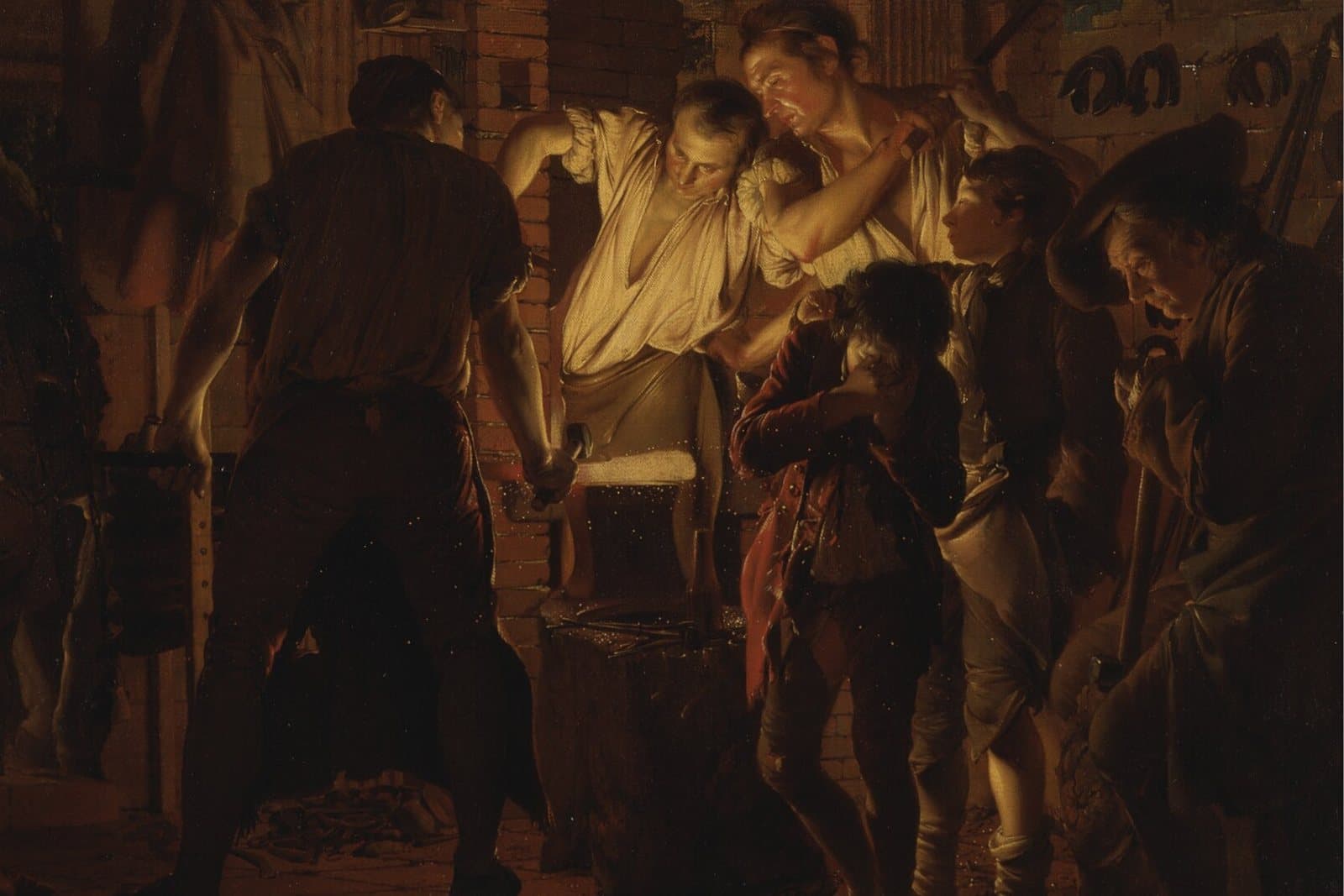
- Joseph Wright of Derby, A Blacksmith’s Shop (1771), detail. Yale Center for British Art, Paul Mellon Collection, via Google Art Project, Public domain.
