
Blog ·
The family story that turned out to be true
I grew up hearing that my great-great-grandfather Felix Borne of Algiers built ships for the Confederacy. Most family stories shrink when you go looking for the paper behind them. The great-uncle who “fought with Jackson” turns out to have been a teamster; the “Cherokee princess” turns out to be nobody. This one held up. But it held up only in part, and the part that did not hold up is the lesson of this post.
Write down what the story claims
A family story is a lead, not a finding. The first step is to break it into claims small enough to test. “Felix built ships for the Confederacy” is really four claims: that he served the Confederacy at all; that he worked as a shipwright rather than a soldier; that he worked on particular ships; and that he built them, rather than repairing or fitting them out. Each claim needs its own record, and the records will not all be equally good.
The second step is making sure you have the right man. Felix Borne is not a common name, but there were at least two in Algiers, since my ancestor had a son of the same name. The service record I found names a Felix Borne of Algiers, by trade a carpenter. That is name plus place plus occupation, which is suggestive and not enough. What tied it to my Felix was his widow’s 1927 pension application: Emma Cararas Borne, whom he married in 1880, applied as the widow of Felix J. Borne of the 30th Louisiana Infantry, and her file repeats the regiment, the detached service at Mobile, and the address where he died. Two independent sets of identifying points agree. Now the service record is his.
What the service record says
Felix enlisted in the Algiers Guards, Captain N. Trépagnier’s company of the Sumter Regiment, on 23 February 1862. He was eighteen or so; his mother’s petition in his father’s 1848 succession says he was five in July 1848, which puts his birth about 1843. The company was at Kenner, just upriver from New Orleans, when the city fell to Farragut’s fleet, and on 1 May 1862 Felix left it there. He was paroled on 10 July 1862 and exchanged near Baton Rouge that October. Ten days later, on 10 October 1862 at Port Hudson, he enlisted again, this time in Company A of the 30th Louisiana Infantry.
Then the record turns into the family story. On 20 January 1863 Thomas Weldon, a contractor building a “war steamer” for the Confederate Navy at Yazoo City, Mississippi, asked for Felix by name as a ship carpenter. General Pemberton’s Special Order 44, dated 13 February 1863, detailed him to Weldon. The ship Weldon was building was the unnamed 310-foot ironclad, the biggest vessel the Confederacy attempted on the western rivers, and it was burned on the stocks on 21 May 1863 as Union gunboats came up the Yazoo.
After Yazoo City the muster rolls carry him as on detached service at Selma, Alabama, in May and June 1863, and at Mobile from July 1863 to February 1865. Selma was the Confederacy’s main naval foundry and shipyard on the Alabama River; Mobile was where the Selma-built ironclads were towed to be armed and finished. The record names the places and the months. It does not name a single ship at either one.
The ships, and what each one rests on
Four ships come up in connection with Felix, and they do not all stand on the same footing.
| When | Where | Ship | What the record says | Strength |
|---|---|---|---|---|
| Spring 1862 | Algiers | Boats for the ram Mississippi | His own 1863 affidavit that he saw John Mahony’s launch, cutter, surf boat and gig completed | Saw them: proven. Built them: hypothesis |
| Jan–May 1863 | Yazoo City, Miss. | Weldon’s 310-ft ironclad | Weldon’s request for him by name; Pemberton’s Special Order 44 | Strong: the contract is named |
| May–Jun 1863 | Selma, Ala. | Unknown | “Detached service at Selma” | Place proven; ship unknown |
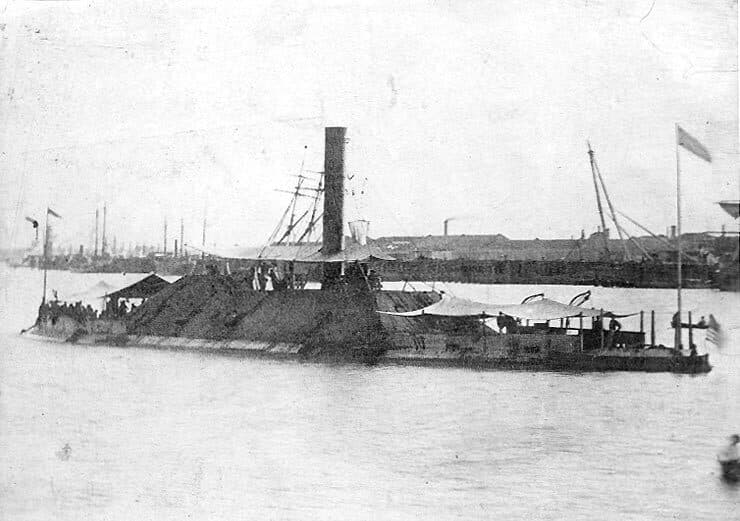
| Jul 1863–Feb 1865 | Mobile, Ala. | CSS Tennessee | Comrade Camille Berthaut’s 1927 affidavit in the widow’s pension file | One late eyewitness; not proven |
The first line is the one I find most interesting, because it is Felix himself speaking. In November 1863, at Mobile, he swore an affidavit for John Mahony, an Algiers boatbuilder trying to get paid by the Confederate government. Felix stated that he had seen the boats Mahony built for the steam ram Mississippi, the big Tift ironclad that was burned unfinished at New Orleans the day the city fell. That proves he was around the Mississippi project in the spring of 1862 and that he knew Mahony’s work well enough to vouch for it. It does not say he built the boats. If I wrote “Felix worked on the CSS Mississippi” I would be writing the family story back into the record.
The last line is the one the family would most like to be true. The CSS Tennessee was the flagship at Mobile Bay, the most famous Confederate ironclad after the Virginia. When Emma Borne applied for a widow’s pension in 1927, a comrade named Camille Berthaut swore that Felix, “a ship joiner by trade”, had been put to work fitting out the gunboat Tennessee at Mobile from about the summer of 1863. The dates fit the muster rolls exactly. But it is one man’s recollection, sworn sixty-four years after the event, in a document whose purpose was to get Felix’s widow a pension. It is evidence. It is not the same thing as a Navy payroll with his name on it, and until one turns up, the Tennessee stays in the “not proven” column.
The brother in the same yards
Felix had an older brother, Theophilus, baptized Pierre Théophile, who was seven in the summer of 1848. A service record for a T. J. Borne of the 7th Louisiana Infantry, a New Orleans carpenter, shows him carried as “absent, detailed in Alabama” and paroled at Mobile on 24 April 1865. The tree says Theophilus married in Mobile that same year. Two carpenters from one Algiers family, both detailed to Alabama, both at Mobile in 1865: it is tempting to picture them in the same shipyard. I have not found Theophilus’s detail order, and the age on his service record is three years off from the succession, so even his identity is only probable. Whether the brothers worked together is unknown, and I write it that way.
After the war
The rest of Felix’s life is better documented than his war, because he became a public man. He was a builder in Algiers Point; the 1886 building permits list two houses he put up on Bouny and Villere Streets. In 1887 the City Council accepted his $750 bid to repair the Algiers fire-alarm tower. In February 1889 the Council elected him to the New Orleans Police Board for the Fifth District, and the Times-Democrat described him as “a prosperous builder… born and raised in Algiers and served with distinction during the late war.”
The police board job turned into a fight. In July 1890 Mayor Shakspeare tried Felix and three fellow commissioners for holding a meeting he had not called, declared them dismissed, and had replacements appointed. The four sued, and in January 1891 the Louisiana Supreme Court ruled the mayor’s action illegal and put them back. That means Felix was off the board when Chief Hennessy was assassinated in October 1890 and back on it when the board chose Hennessy’s successor the following January. He kept the seat until 1896. Later he ran a hardware store on Patterson Street, and in December 1919 Governor Pleasant appointed him, “hardware merchant”, to the Orleans Levee Board. He died at 332 Olivier Street, Algiers, on 9 September 1926, and was buried at McDonogh Cemetery in Gretna.
Two conflicts, and how they were settled
The tree I inherited had Felix dying on 12 April 1933. Four records, the Orleans death index, two obituaries and his Find a Grave entry, say 9 September 1926. When four independent records agree against an unsourced tree entry, the records win, and the 1933 date is probably a mix-up with another Felix. I changed the working tree and kept the old value in a note, so that nobody wonders later where 1933 came from.
His birth year is still open. The tree says 24 May 1844; the 1900 census implies 1847; voter registrations say 1846 in St. John the Baptist Parish; his obituary makes him 80 and the pension file 82; and his mother’s sworn petition of July 1848, the earliest and closest to the event, says he was five. I give “about 1843” and list the rest. A baptism from St. John the Baptist Parish would settle it, and it is on the list.
What the papers prove
- Felix Borne of Algiers served the Confederacy, 1862–1865, in two Louisiana infantry units.
- He was detailed from the 30th Louisiana as a ship carpenter to Thomas Weldon’s war steamer at Yazoo City in February 1863.
- He was on detached service at Selma (May–June 1863) and Mobile (July 1863 – February 1865), the Confederacy’s naval yards on the Gulf.
- In November 1863 he swore that he had seen the boats John Mahony built for the ram Mississippi.
- The service record is his: the widow’s pension file ties it to the Felix who married Emma Cararas.
- He died 9 September 1926, not 1933.
What isn’t proven yet
- Which ships he worked on at Selma and at Mobile. The rolls name the places, not the vessels.
- That he built the Mississippi’s boats. He said he saw them.
- That he fitted out the CSS Tennessee. One comrade’s affidavit, sixty-four years on, is evidence and not proof.
- His exact birth date, and that the T. J. Borne of the 7th Louisiana is his brother Theophilus (probable).
The story was true. But “true” had edges, and the edges are where genealogists earn their keep. Our house rule is that a fact without a source is a lead, not a finding. The family story gave me the lead. The service record gave me the finding. And the pension file, the one that sounds best, gave me a hypothesis that I will keep testing, in the same spirit as the DNA and tree question: the two can both be right and still not say the same thing.
Sources
- Compiled service record, Felix Borne, Co. A, 30th Louisiana Infantry; Compiled Service Records of Confederate Soldiers Who Served in Organizations from the State of Louisiana, NARA microfilm M320; images, Fold3.
- Confederate Citizens File, John Mahony, Algiers; Confederate Papers Relating to Citizens or Business Firms, NARA M346; images, Fold3. Contains Felix Borne’s affidavit of 7 November 1863, Mobile.
- Louisiana Confederate pension application of Emma Borne, widow of Felix J. Borne, 1927; Louisiana State Archives, Baton Rouge; images, FamilySearch. Includes the affidavit of Camille Berthaut.
- Succession of Antoine Benjamin Borne, No. 2556 (1848), First District Court, Orleans Parish; widow’s petition listing the minor children and their ages.
- Times-Democrat (New Orleans), 21 Feb 1889, p. 3; Times-Picayune, 8 Jul 1890, p. 2; Daily Picayune, 8 Jan 1891, p. 4; Times-Picayune, 16 Dec 1919, p. 1; New Orleans Item, 10 Sep 1926, p. 2; Times-Picayune, 11 Sep 1926, p. 7.
- Full citations for every record are in the research files for Jean Felix Borne (1843–1926) and Theophilus Joseph Borne (1841–1874).
Image credits
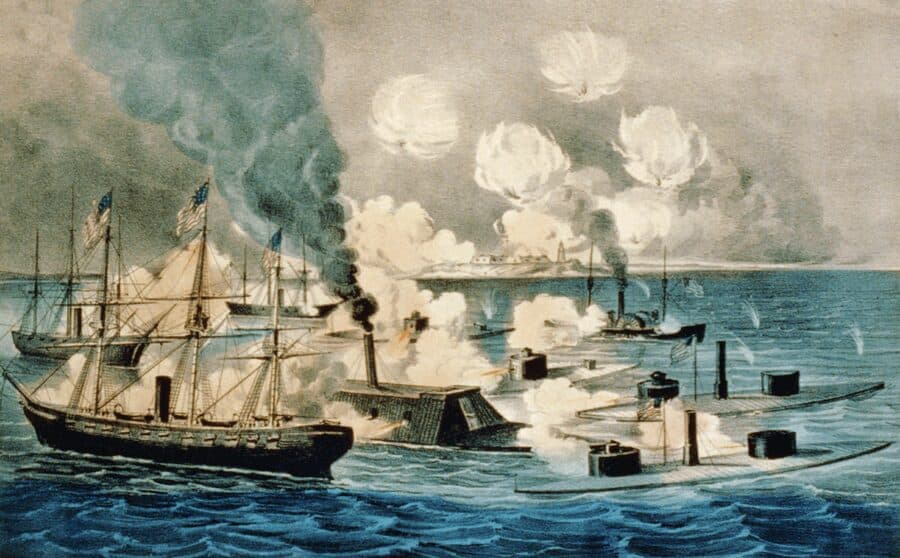
- Currier & Ives, Battle of Mobile Bay (after 1863), hand-coloured lithograph. Library of Congress, Prints and Photographs Division, via Wikimedia Commons, Public domain.
- CSS Tennessee, photograph, 1865 (NH 60335). U.S. Naval History and Heritage Command, via Wikimedia Commons, Public domain.
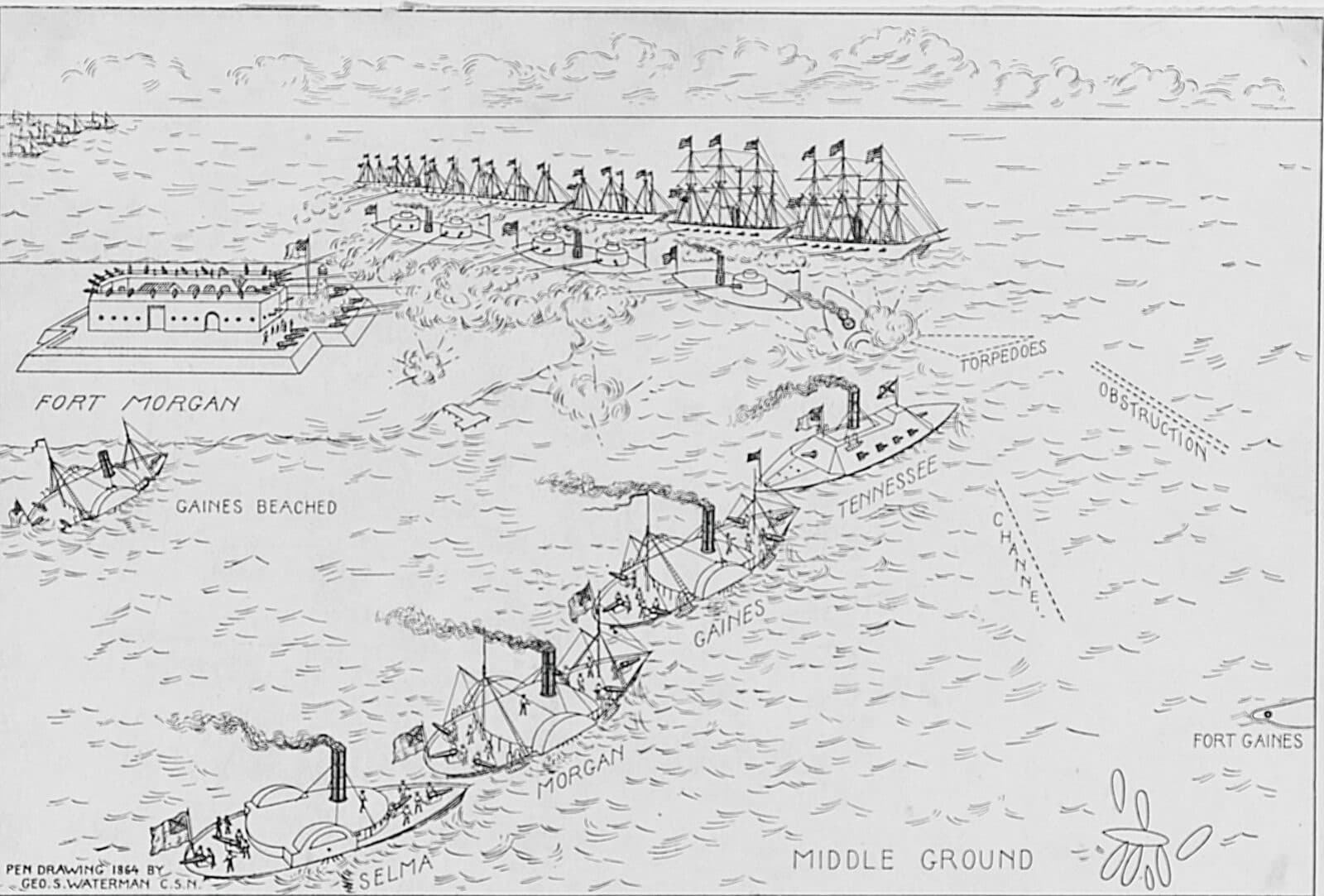
- George S. Waterman, C.S.N., Battle of Mobile Bay, pen drawing, 1864. U.S. Naval History and Heritage Command, via Wikimedia Commons, Public domain.
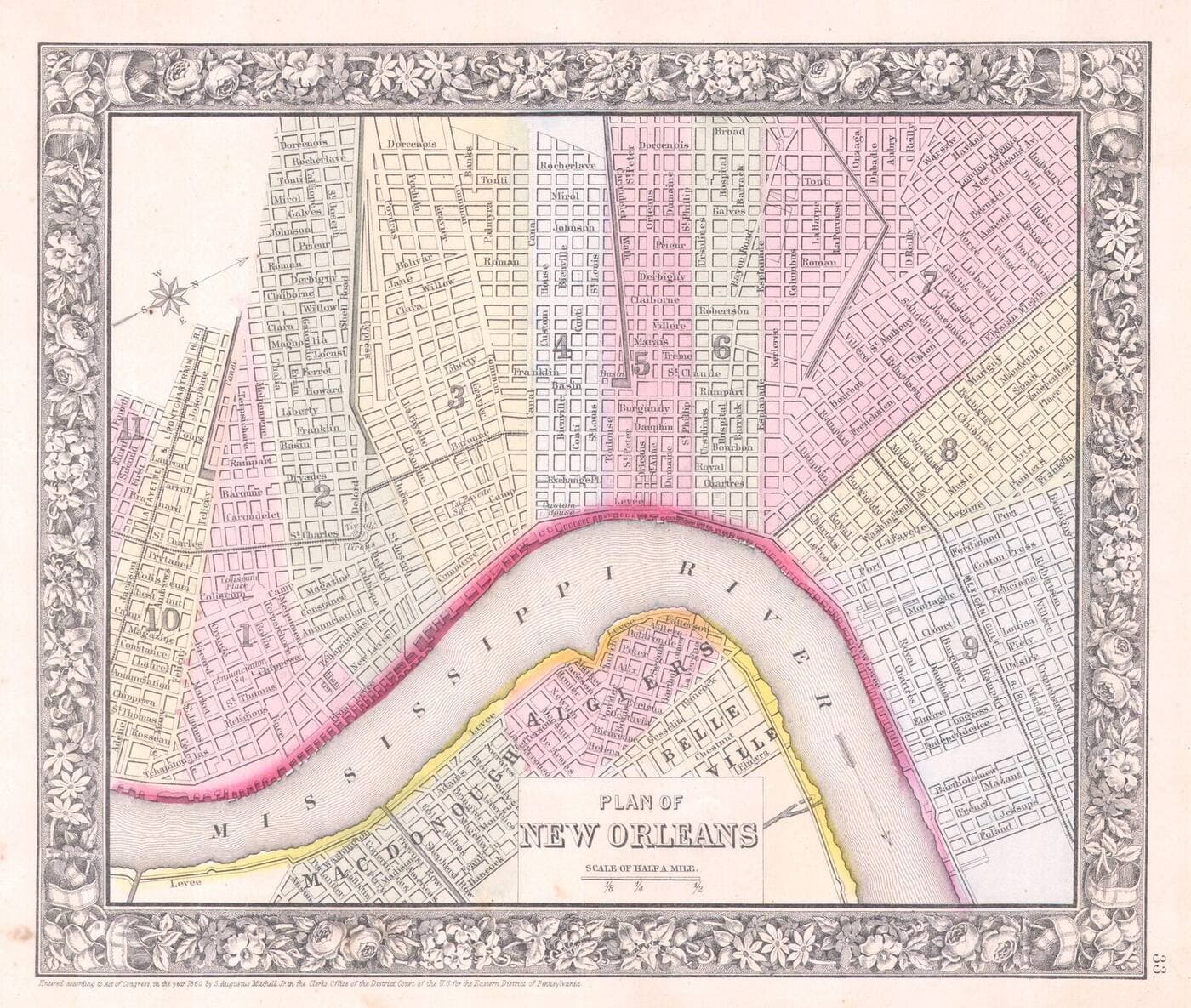
- S. Augustus Mitchell, Plan of New Orleans, 1860 (1864 edition). Geographicus Rare Antique Maps, via Wikimedia Commons, Public domain.