
Blog ·
The other Claiborne Thibodaux
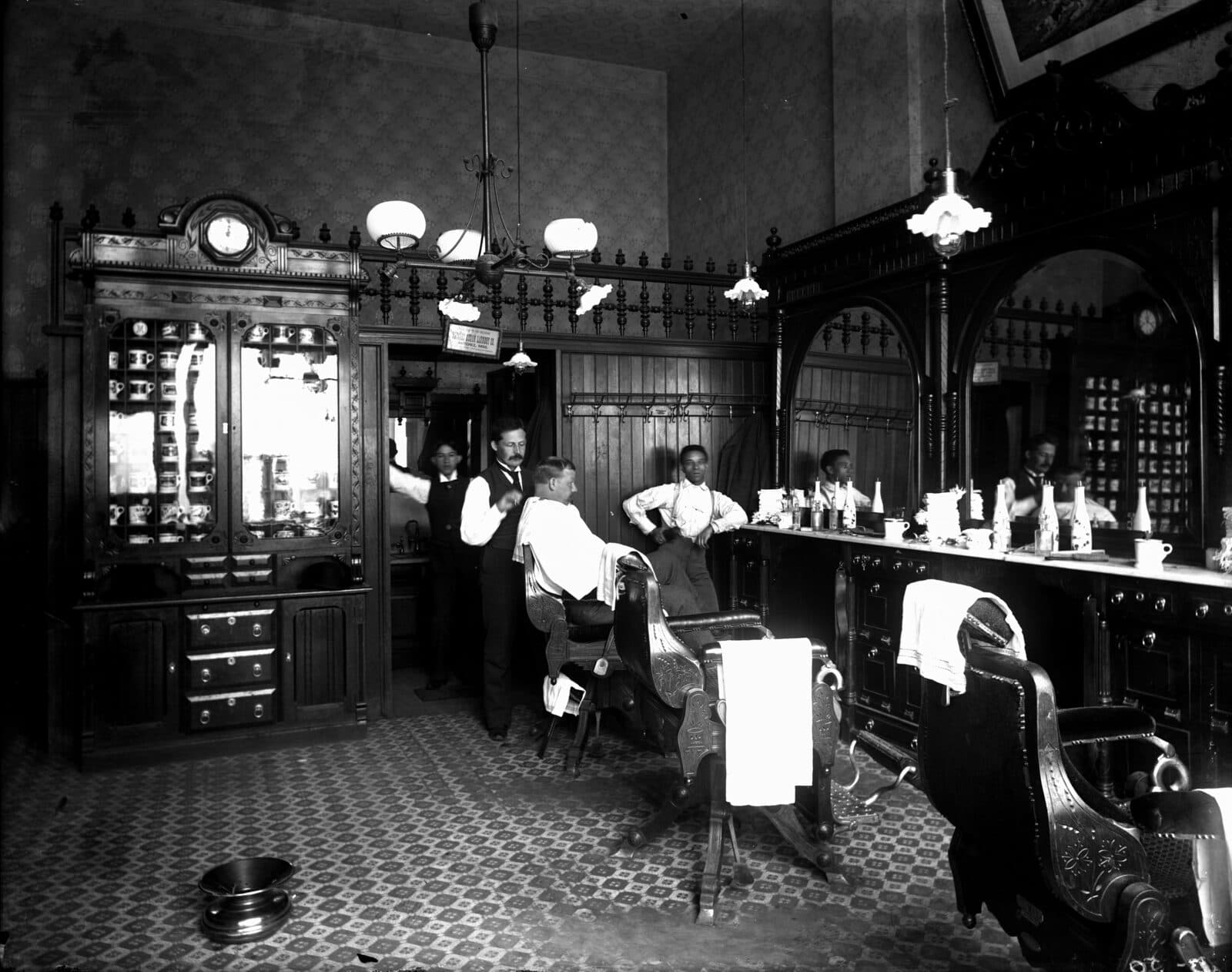
My great-great-grandfather Claiborne Thibodaux was a barber in the town of Thibodaux, Louisiana. His first cousin, also named Claiborne Thibodaux, was born three years earlier in the same parishes. The family tree I inherited gave my Claiborne a birth date of 1 September 1857. My Claiborne was born about 1858. The cousin was born on 2 September 1854. Look at that date again. It is almost certainly two men blended into one, and this post is about how that happens and the rule we use to stop it.
Two Claibornes
Henry Schuyler Thibodaux, the acting governor I wrote about in an earlier post, had several sons, and two of them, Michel Henri and Henri Claiborne, each named a son Claiborne. The boys grew up a few miles apart on the bayous of Terrebonne and Lafourche. Here is what separates them.
| Ours | The cousin | |
|---|---|---|
| Born | Abt 1858, Terrebonne (age 2 on 16 Jul 1860) | 2 Sep 1854, Lafourche; christened 24 May 1856 |
| Parents | Michel Henri Thibodaux × Azelie Lirette | Henri Claiborne Thibodaux × Mathilde Toups |
| 1860 census | 10th Ward, Terrebonne: M. H. Thibodaux 59, Azelie 23, Schuyler 4, Claiborne 2 | 2nd Ward, Terrebonne: H. C. Thibodaux household, Claiborne abt 6 |
| 1880 census | “Claib Thibodeaux, 22”, stepson of André Maronge, Azelie’s second husband | Not traced |
| Married | Marie Bergeron, St. François de Sales, Houma, 18 Jan 1883 | Not traced |
| Occupation | Barber, Thibodaux, 1900 and 1910 | Not traced |
| Died | 23 Dec 1920, Thibodaux; death index names parents Michel and Azelie Lirette | Not traced |
Our Claiborne is pinned down by three records that agree with each other and with nothing in the cousin’s file: the 1860 household with Azelie and his brother Schuyler, the 1880 household where he is the stepson of Azelie’s new husband, and the 1920 death index naming Michel and Azelie Lirette as his parents. Name plus mother plus brother in 1860; name plus mother plus stepfather in 1880; name plus both parents in 1920. The cousin is Henri Claiborne’s son by Mathilde Toups and is in a different household in the same census year. They cannot be the same person.
So where did “1 September 1857” come from? No record we have found gives a day of birth for our Claiborne at all. The 1860 census gives an age, the 1900 census gives “Sept 1848”, which is an enumerator’s slip, and the death index gives 1858. The cousin’s baptism gives 2 September 1854. A tree that has “September” from one man and “2” from the other, then rounds to a year that splits the difference, produces 1 September 1857. I cannot prove that is what happened, and I do not need to. What I can say is that the day in the tree has no source, and that it sits one day and three years from a documented date belonging to a different man. His exact birthday is not proven, and the tree now says so.
A man built from three men
The Thibodaux case is a near miss. The McElveen case is the full disaster. The tree gave my 5×-great-grandfather as “William Emanuel McElveen Sr”, born 10 May 1757 or alternatively 1745, died 8 April 1837 or alternatively 1807, husband of Esther and of Rhodicy and of a “Margaret McCrae”. That is not a man. That is a pile.
His own Revolutionary War pension file, S.21880, sorts it out. In 1832 William McElveen Senr of Sumter District, South Carolina, swore that he was born on 10 May 1757, according to “a record of his age”, in the place where he had lived all his life, and that he had served in the militia from 1776 to 1782, part of it in Francis Marion’s brigade. The pension office recorded his death on 8 April 1837 and paid the arrears to his widow, Rhody. A sheriff’s deed of 1838 and the estate accounts of 1841 confirm the widow and the land on Pudding Swamp.

The rest of the pile belongs to other people. “Emanuel” is the middle name of a William Emanuel McElveen of Bulloch County, Georgia, who died about 1826. The 1745 birth, the 1807 death and the wife Margaret McCrae belong to a William McIlveen Senr of Prince Frederick’s Parish, whose will was proved in 1807, thirty years before our William died. Somebody, somewhere, searching for “William McElveen Sr, South Carolina”, found all three, could not tell them apart, and kept everything. On 17 October 2026, with my approval, the borrowed details were removed from the working tree. What is left is one man, born 1757, died 1837, widow Rhody, parents unknown. Smaller, and true.
How merges happen
Nobody sets out to build a man from three men. It happens one hint at a time. A tree site suggests a record for “William McElveen, South Carolina, born about 1750”. The record is a will from 1807. The name matches, the state matches, the decade is near enough, and the button says Accept. Now the tree has a death in 1807. Next week it suggests a pension file for a William McElveen who died in 1837, and that gets accepted too, because the name matches, and the software is happy to hold two death dates. The “alternative” fields exist precisely so that conflicts can be stored instead of resolved. Over a few years, and a few hundred trees copying each other, the alternatives harden into a biography.
Name reuse makes it worse. Louisiana French families named a boy for his father or uncle and a girl for her aunt, and English-speaking Southern families did the same with Williams and Johns. In a district with three William McElveens and two Claibornes, a search by name alone will always return someone, and the someone it returns will usually have a plausible record attached. The hint system is not wrong to offer it. The researcher is wrong to take it without checking the second point.
The rule
We call it the two-identifying-points rule, and it is the single most useful habit in this work. A record belongs to your person only when at least two independent identifying points agree, with no unresolved conflict. The points are things like name, age or birth year, place, and a named relative: a spouse, a parent, a child, a sibling. Name plus place is never enough in a family that reuses names, and every Louisiana French family reused names. Name plus place plus a brother called Schuyler is a different matter. Name plus place plus a widow called Rhody, in a file the man signed himself, is better still.
The second half of the rule is the lookalike sweep. Before accepting a match, deliberately go looking for every other person of that name and roughly that age in the area, and rule each one in or out, in writing, before you take the record. It feels like wasted effort right up to the day it is not. In the Thibodaux case the sweep found the cousin. In the McElveen case it found two other Williams whose details had already been absorbed. In our files each lookalike gets a note of his own, with what would confirm or exclude him, so that he cannot drift back in the next time someone searches the name.
The pattern is everywhere. In the same month our files picked up a passenger on an 1872 Hamburg list with the right name and the wrong village, and a man in Hoboken with the right name and the wrong wife. Each got a note. Each was ruled out. Neither will be back.
What a lookalike note looks like, in case it is useful: the name as the record spells it; the record and where to find it again; the points that match ours; the points that do not; and one line on what would change the verdict. For the cousin Claiborne it reads, in short: born 2 Sep 1854, parents Henri Claiborne × Mathilde Toups; matches name and parishes; conflicts on parents and household in 1860; must not be merged with the 1883 groom unless a record says so. That last line is the important one. It tells the next researcher, who may be me in two years, that the question was asked and what answer would reopen it.
What the papers prove
- The two Claiborne Thibodauxs were different men, with different parents, in different households in 1860.
- Our Claiborne was the son of Michel Henri Thibodaux and Azelie Lirette, married Marie Bergeron in 1883, and died 23 December 1920.
- William McElveen Sr of Sumter District was born 10 May 1757 and died 8 April 1837, leaving a widow Rhody, by his own pension file.
- “Emanuel”, the 1745 and 1807 dates and “Margaret McCrae” belong to two other men.
What isn’t proven yet
- Our Claiborne’s exact day of birth. The tree’s 1 September 1857 is unsupported and is now flagged.
- Michel Henri as his father is probable, close to proven; Michel Henri’s 1861 succession in the Terrebonne clerk’s office would settle it.
- William McElveen Sr’s parents. The pension file names none.
Sources
- 1860 U.S. census, Terrebonne Parish, Louisiana, 10th Ward, M. H. Thibodaux household; 2nd Ward, H. C. Thibodaux household. 1880 U.S. census, Terrebonne Parish, André Maronge household. 1900 and 1910 U.S. censuses, Lafourche Parish, town of Thibodaux, Claiborne Thibodaux household.
- Louisiana Statewide Death Index, Claiborne Thibodaux, 23 Dec 1920, Lafourche (FamilySearch F33L-WW1). “Louisiana, Marriages, 1816–1906”, Claiborne Thibodeaux and Marie Bergeron, 18 Jan 1883, Houma (FamilySearch F4Z4-LJM).
- Baptism of Henri Claiborne Thibodaux, b. 2 Sep 1854, christened 24 May 1856, Lafourche (FamilySearch F832-H31).
- William McElveen (Sumter District, S.C.), pension file S.21880, Revolutionary War Pension and Bounty-Land Warrant Application Files, NARA M804, roll 1679; images, FamilySearch DGS 004160868, images 743–755.
- Sumter District, S.C., Conveyances, vol. II-KK, p. 657, sheriff’s deed, 10 Jan 1838; Court of Ordinary, estate papers, bundle 64, pkg 3, estate of William McElveen Sr., account of shares 1841; images, FamilySearch.
- Full citations are in the research files for Claiborne Thibodaux, Henri Claiborne Thibodaux and William McElveen Sr.
Image credits
- Natchez Hotel barber shop, photograph, 1890s. Wikimedia Commons, Public domain.
- William Tylee Ranney, Marion Crossing the Pee Dee (1850), oil on canvas (detail). Amon Carter Museum of American Art, via Wikimedia Commons, Public domain.
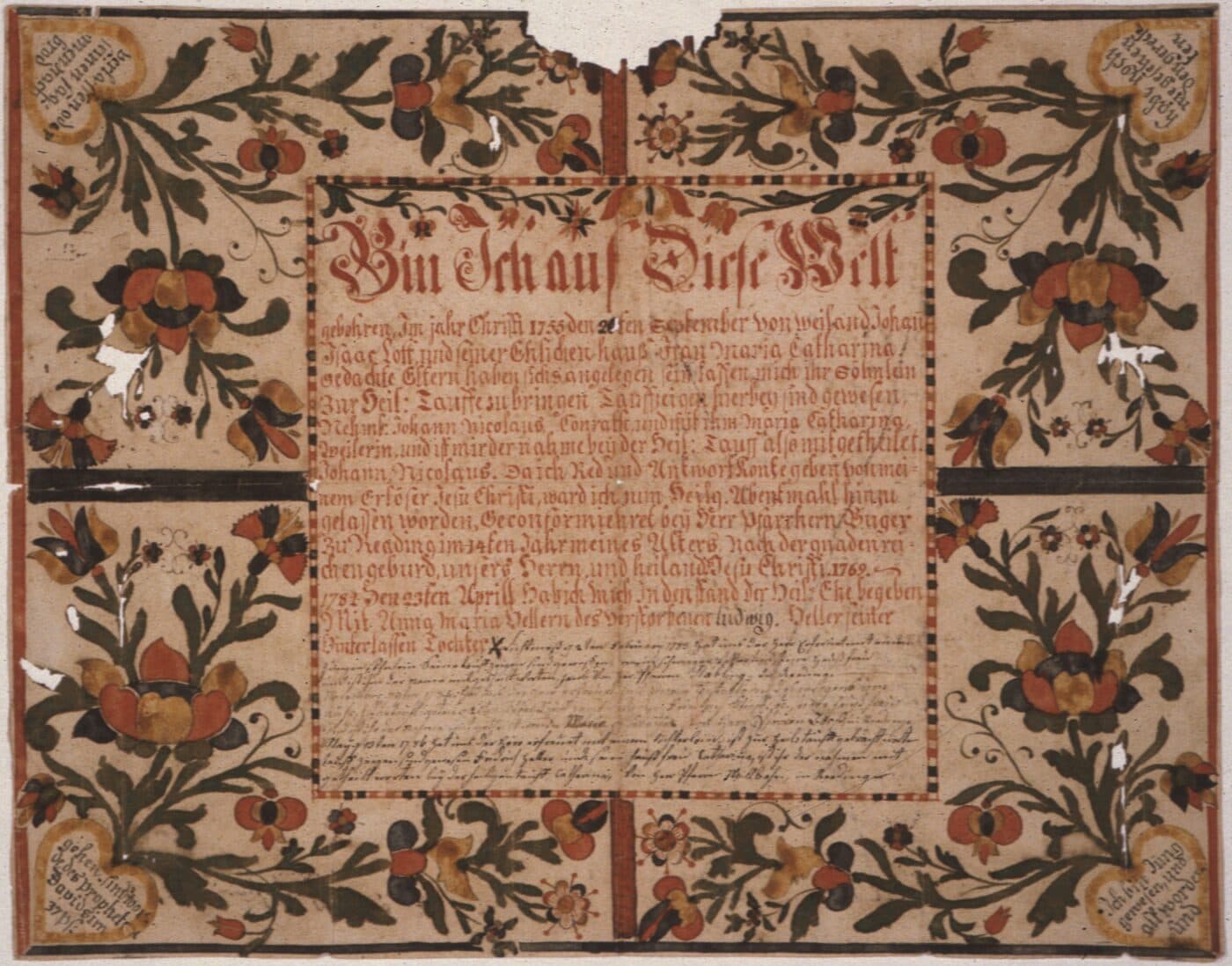
- Illustrated family record (Fraktur) found in a Revolutionary War pension and bounty-land warrant application file. U.S. National Archives and Records Administration (NARA 300199), via Wikimedia Commons, Public domain.