
Blog ·
The Acadian ancestor who probably wasn’t
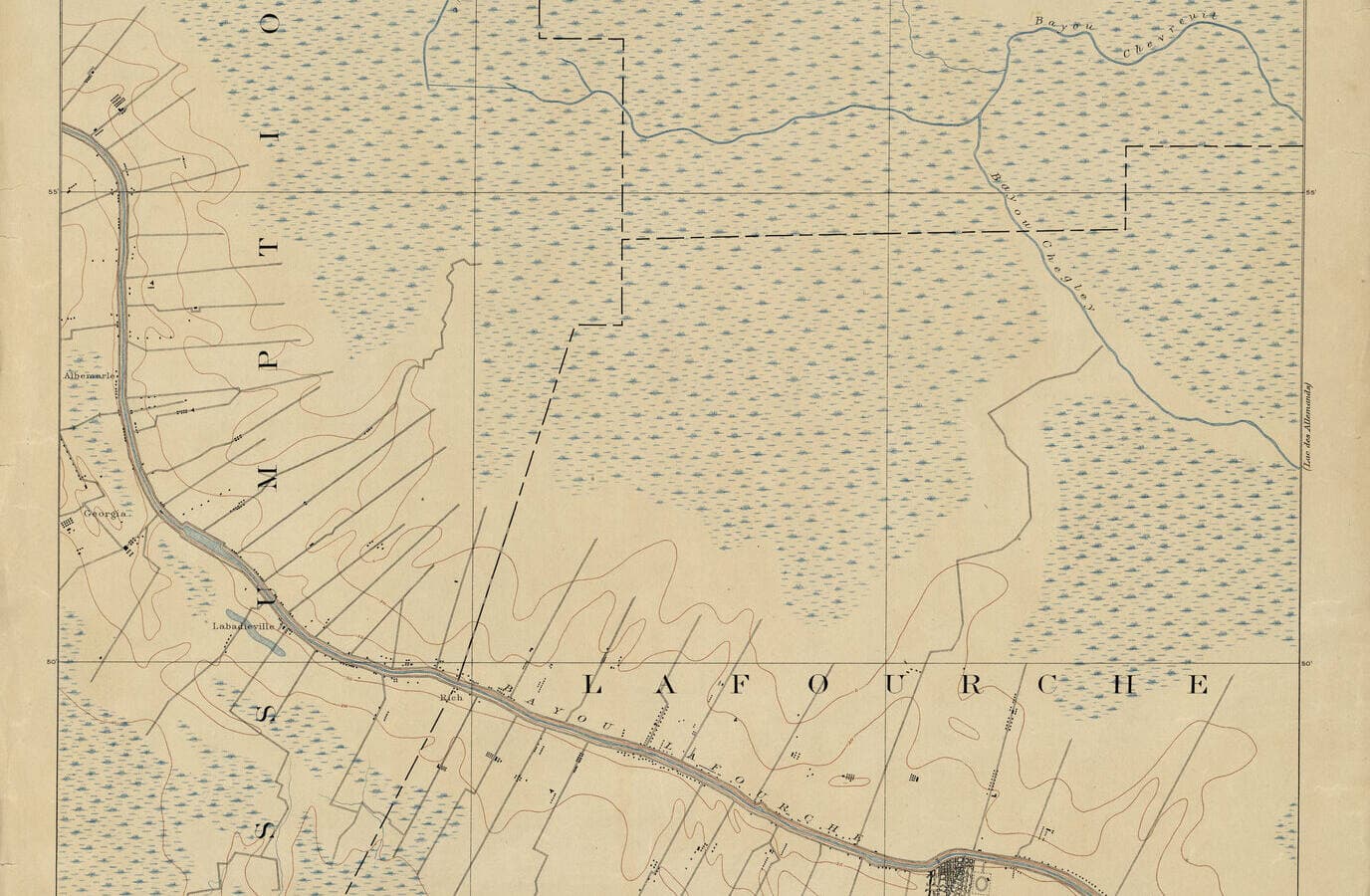
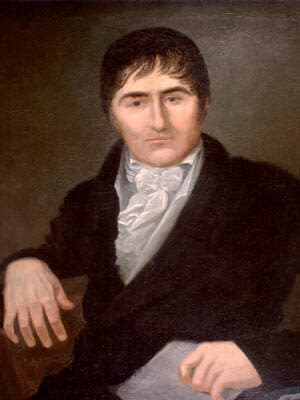
The town of Thibodaux, Louisiana, is named for my 4×-great-grandfather. Henry Schuyler Thibodaux was a state senator, and for four weeks in the winter of 1824 he was acting governor of the state. Online trees carry him back through the Acadian Thibodeaux to Port-Royal in the 1600s, and they can cite him for it: in his own marriage petition he named his parents as Alexis Thibodeau and Anne Blanchard, and an Acadian couple of exactly those names existed. Case closed? Not quite. The records of that couple say he could not have been their son. This is everything we have found on him, record by record, with what each one proves, what it does not, and what it would take to finish the job.
What he said about himself
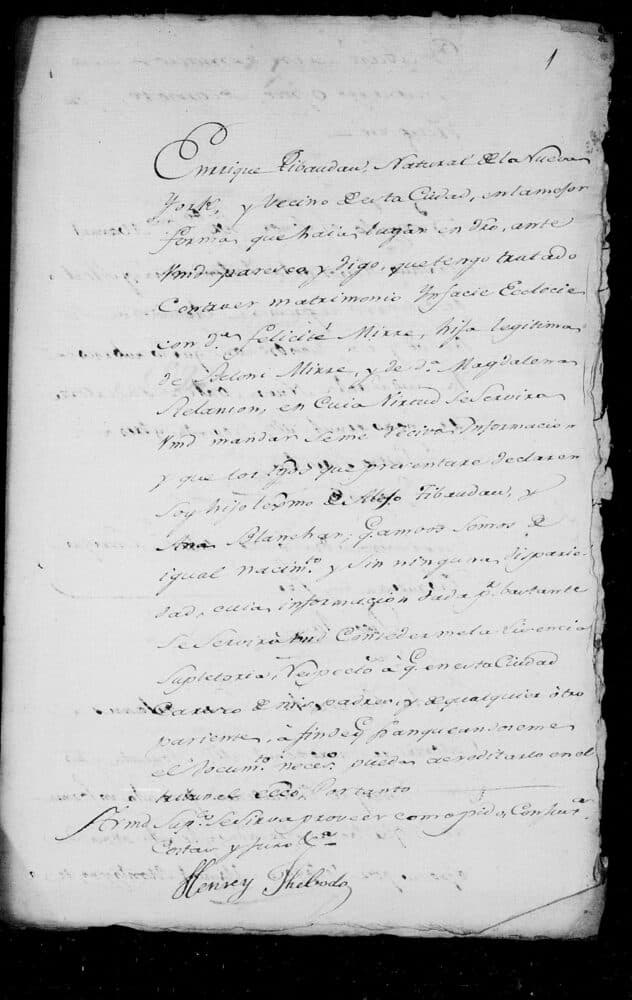
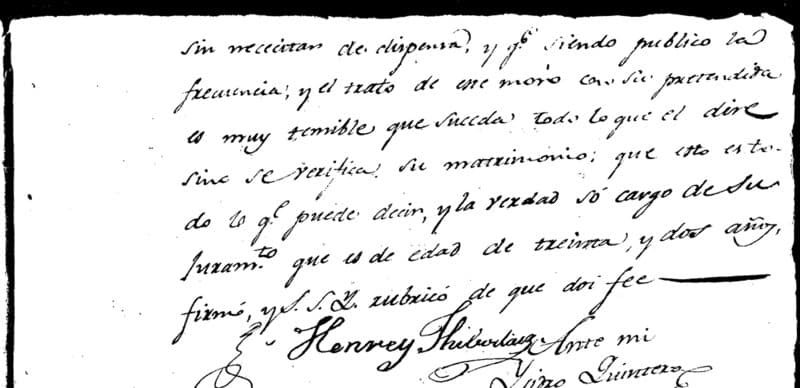
On 14 January 1793 a young man walked into the Cabildo in New Orleans and petitioned the Spanish authorities for leave to marry Félicité Bonvillain (the clerk wrote her as Mirre, her stepfather’s name). The petition is in a clerk’s hand: Enrique Tibaudau, “natural de la Nueva York”, resident of this city, the legitimate son of Alejo Tibaudau and Ana Blanchar, with no parents or any other relative in the city. Two witnesses, Miguel Montigni, 24, and Luis Laforete, 22, both unable to write, repeated the petition word for word, so they add nothing he did not tell them. The licence was granted the next day. The only part of the document in Henry’s own hand is the signature, and it is worth looking at.
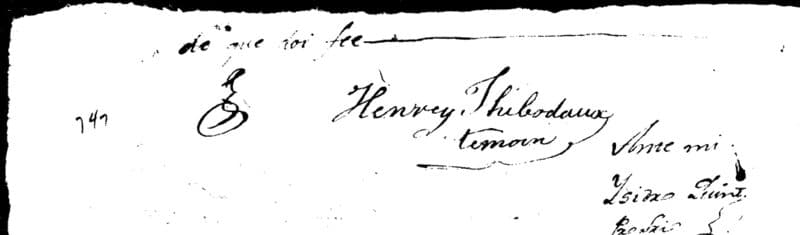
“Henrey.” It is not how anyone spelled the name, in English or French, and he kept doing it. In October 1796 he was a witness in a marriage dispensation at Plaquemine and signed “Henrey Thibodaux, témoin”. In July 1798 he was a witness in another at New Orleans and signed “Henrey Thibodaux” again. In May 1799 a Baton Rouge bond was signed, as the archive’s translator typed it, “HENREY THIBODAUX”. That spelling ties four records in three places to one man before any of them says the word Schuyler, and it is the thread the rest of this post hangs on.
How old was he?
Published dates for Henry range from “before 1762” to 1769, and none of them rests on a record. The two dispensation files do. He swore he was 29 on 14 October 1796 and 32 on 9 July 1798. Twenty-one months apart, both in documents he signed, both consistent: born about 1765 to 1767. Sworn ages in church files are not perfect, but two that agree are the best evidence we have, and the 1769 in the trees is supported by nothing.
The couple he named
There was an Acadian Alexis Thibodeau married to a Marie-Anne Blanchard. They are real, and they are the reason every online tree runs Henry back to Acadia. So we read all seventeen surviving records of that Alexis, from Acadia through the deportation to Quebec, and the notarial acts of his sons.
| Fact about the Acadian couple | Record | What it means for Henry |
|---|---|---|
| Marie-Anne Blanchard died about 1756–1760, before February 1762 | Alexis’s remarriage to Catherine Le Blanc and later acts | A son of hers born 1765–67 is impossible |
| Her children were Marie, Simon and Étienne | Baptisms; the Quebec notarial act of 4 March 1782, which counts three living children of the first marriage | No Henri in the family |
| Alexis’s later son Joseph (b. abt 1761) was by Catherine Le Blanc | Baptism; the 1782 act | The only child of the right decade has a different mother |
| The family went Philadelphia → Boston (1764) → Quebec (1767) | Exile petitions and passenger lists; an undated Massachusetts list of Acadian families has “alexis tibodau, 3 de sa famille” | Never in New York, and a household of three leaves no room for a Henry |
| Son Simon, a potter, lived at St-Denis-sur-Richelieu near Montréal 1782–1819 | His 1775 marriage contract, 1782 renunciation, 1816 inventory and 1819 burial, all read | The one relative in the right place at the right time; no Henri in his family or acts |
Put the two halves together. Henry said he was born in New York, about 1765–67, to Alexis Thibodeau and Anne Blanchard. The only Alexis Thibodeau and Anne Blanchard anyone has found had no connection to New York, and she had been dead for at least three years when Henry was born. His claim does not fit the couple he named.
“Schuyler”
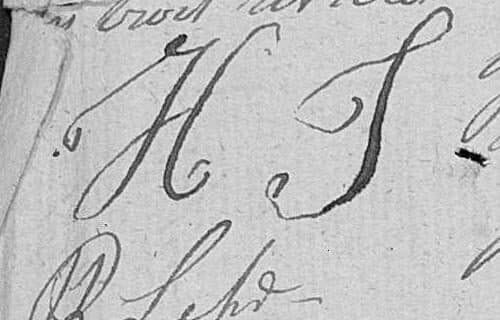
The middle name is the other reason the Albany story has legs. Schuyler was the great family of Albany, and a French Canadian boy carrying that name invites a theory: that he was raised in the Schuyler household, or was a Schuyler by blood. A Montréal notarial contract of 1788 carries marginal initials next to the signature of a young Thibaudau, and an earlier reading of them was “H S”. When the image was re-read on 18 October 2026 against the other engagés’ initials in the same notary’s book, they are “H T”, Henry Thybaudau, first name and surname, the way everyone else initialled. That link is withdrawn.
The earliest records of the middle name we have are a Terrebonne deed abstract of 29 September 1809, “Henry Schuler Thibodaux”, and the Baton Rouge church abstracts, where he stands godfather as “Henry Skyler” in 1806 and “Henri Scaeler” in 1808, and his daughter Elmire’s baptism that August calls him “Henri Scailer, of New York”. His own will of 1817 is signed “Henry Scuyler Thibodaux”. Where the name came from, and when he took it, is open. Philip Schuyler’s will names no Henry; Albany church indexes have no Thibodeau; the Schuyler finding aids are silent.
The trail before Louisiana
If his origin is a blank, his twenties are not quite. Three records in three places may be one man, and the route they trace is the fur trade’s own road.
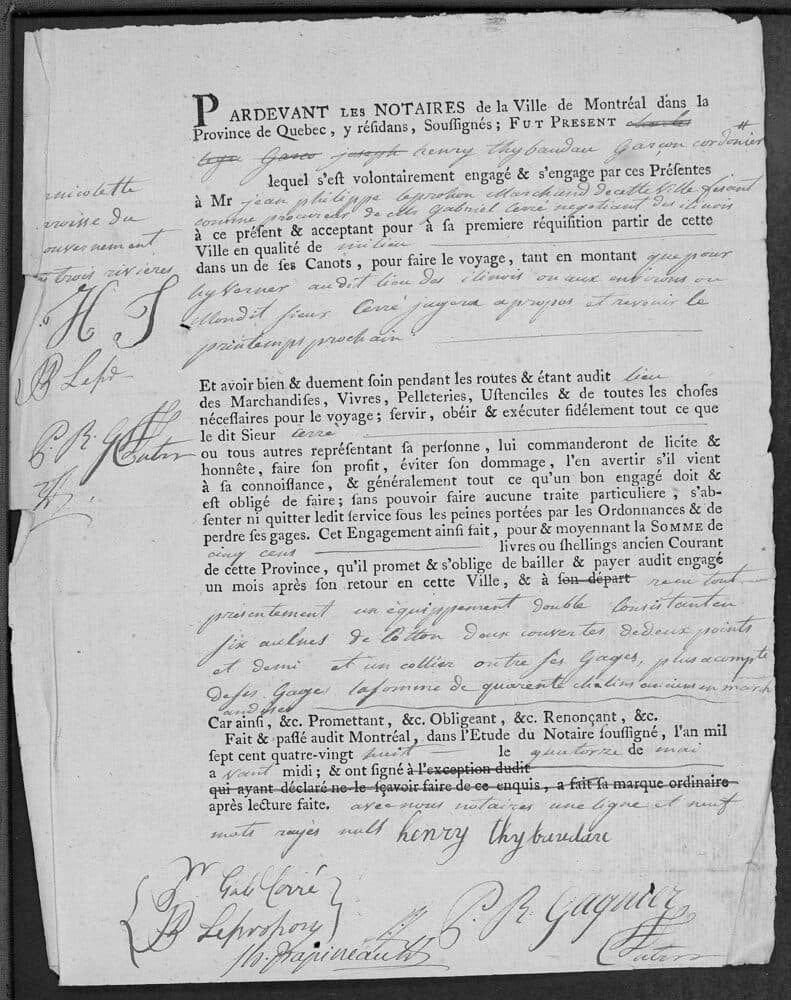
- Montréal, 14 May 1788. Before the notary Gagnier, “henry Thybaudau, garçon cordonnier”, a journeyman shoemaker, hired on as a canoeman for Gabriel Cerré’s brigade to winter in the Illinois country. He signed. A Pierre Thibaudeau signed on for the same brigade nine days earlier; whether they were related is unknown. Gagnier’s books for 1787–90 were read in full: no other act for Henry, and no apprenticeship, which would have named a parent. A letter among the LSU plantation papers, cited by an earlier researcher and not yet seen by us, is said to call Henry “a good shoemaker”. That is a pointer, and a nice one.
- St. Charles, Upper Louisiana, by 18 November 1791. The inventory of a neighbour’s estate on Main Street bounds a lot “du côté du Nord au terrain de Henry Thibeaudeau”. One of the appraisers, Jean-Baptiste Sénécal, was probably the blacksmith engagé from the same 1788 Cerré brigade, spelled the same odd way in both records. Two other Henri Thibaults in the region were checked and ruled out, one born 1786, one baptized 1810.
- St. James Parish, Louisiana, 17 September 1792. Henry witnesses a marriage: the earliest Louisiana record. Four months later he is at the Cabildo asking to marry.
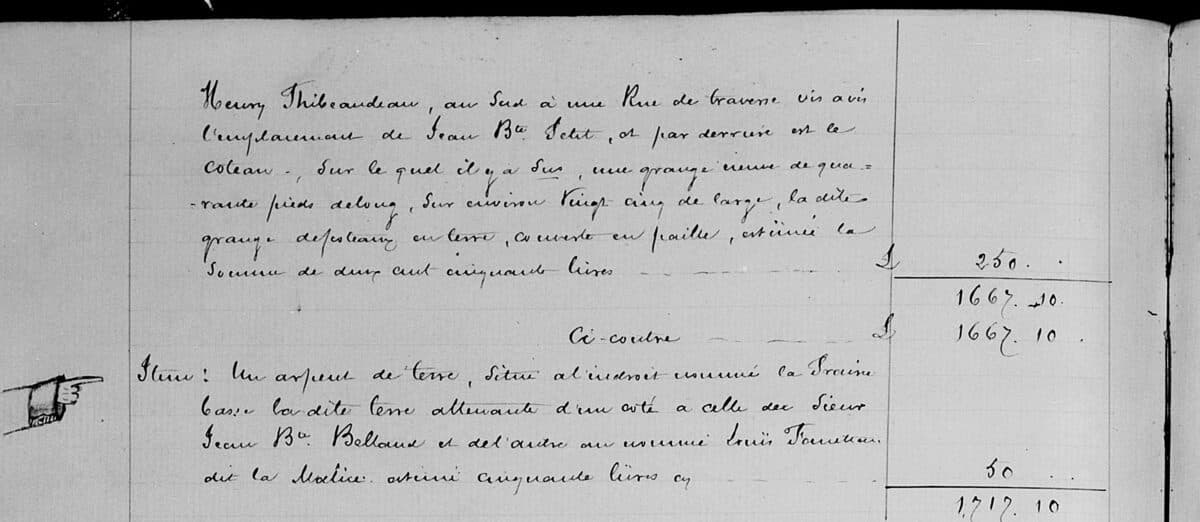
Montréal to the Illinois to the Missouri settlements to the river below New Orleans, in the right order and the right years. But each step rests on a different record, the handwriting of 1788 and 1793 has not been formally matched, and no record names the Montréal shoemaker’s parents either. Each identification is a strong candidate. None is proven, and the chain is only as good as its weakest link.
Thirty-five years in Louisiana
From 1792 the record is continuous and, for a man of his standing, rich. Here is the spine of it, with the status of each record in our files.
| Date | Record | What it shows | Status |
|---|---|---|---|
| 17 Sep 1792 | Marriage witness, St. James | Earliest Louisiana record | Abstract |
| 14–15 Jan 1793 | Marriage petition, New Orleans Cabildo | “Native of New York”, son of Alexis × Anne Blanchard; no kin in the province; signed | Original, verified |
| 7 May 1793 | Marriage to Félicité Bonvillain, St. James | Parents “of New York in America” | Abstract; images ordered |
| 1795–98 | Baptisms of Leandre, Aubin, Eugénie, St. James | Paternal grandparents Alexis × Anne Blanchard | Abstracts |
| 14 Oct 1796 | Dispensation witness, Plaquemine | Aged 29; signed “Henrey Thibodaux” | Original, verified |
| 9 Jul 1798 | Dispensation witness, New Orleans | Aged 32; signed “Henrey Thibodaux” | Original, verified |
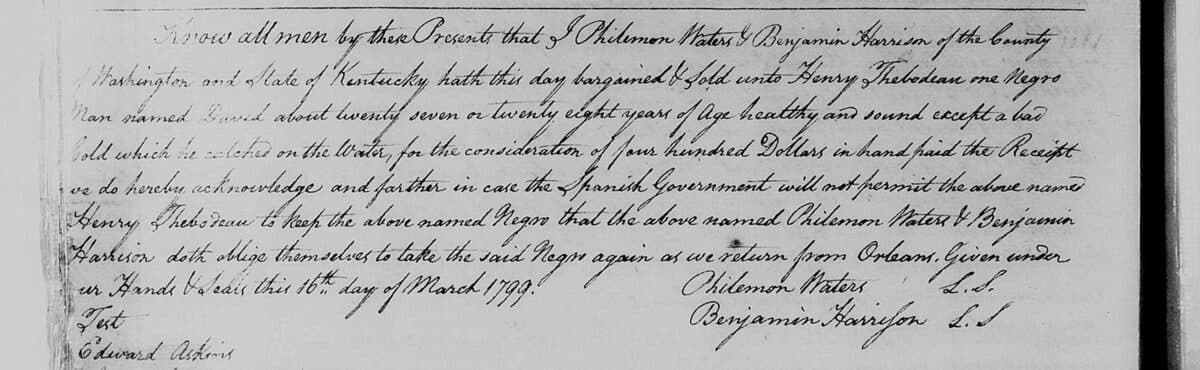
| 16 Mar 1799 | Bill of sale, Natchez | A “Henry Thebodeau” buys David, 27–28, for $400 from Kentucky boatmen | Record copy; strong candidate |
| 28 May 1799 | Bond, Baton Rouge | “Contractor for the meat of the post”; borrows 400 pesos; signed “Henrey Thibodaux” | WPA translation, verified |
| 17 Sep 1799 | Power of attorney, Baton Rouge | An enslaved man seized in the butcher’s hands for 61 cattle bought on credit | WPA translation, verified |
| 3 Jun 1800 | Marriage to Brigitte Bélanger, Baton Rouge | “Of Canada” | Abstract; images ordered |
| 1801, 1805 | Lot bought and part sold, Baton Rouge | “Henry Thibodaux, a butcher” in 1805 | WPA translations, verified |
| 1802–1809 | Land on Bayou Terrebonne and Bayou Lafourche | Cession of Spanish-concession lands to Henry (1802); sale to Judge Goforth (1809) | Abstracts |
| 1806–1808 | Godfather, Baton Rouge church | “Henry Skyler”, “Henri Scailer, of New York” | Abstracts |
| 29 Mar 1809 | Inventory, Interior Lafourche | Plantation valued $6,000; three enslaved people, George, Margrete and Boue | Transcription |
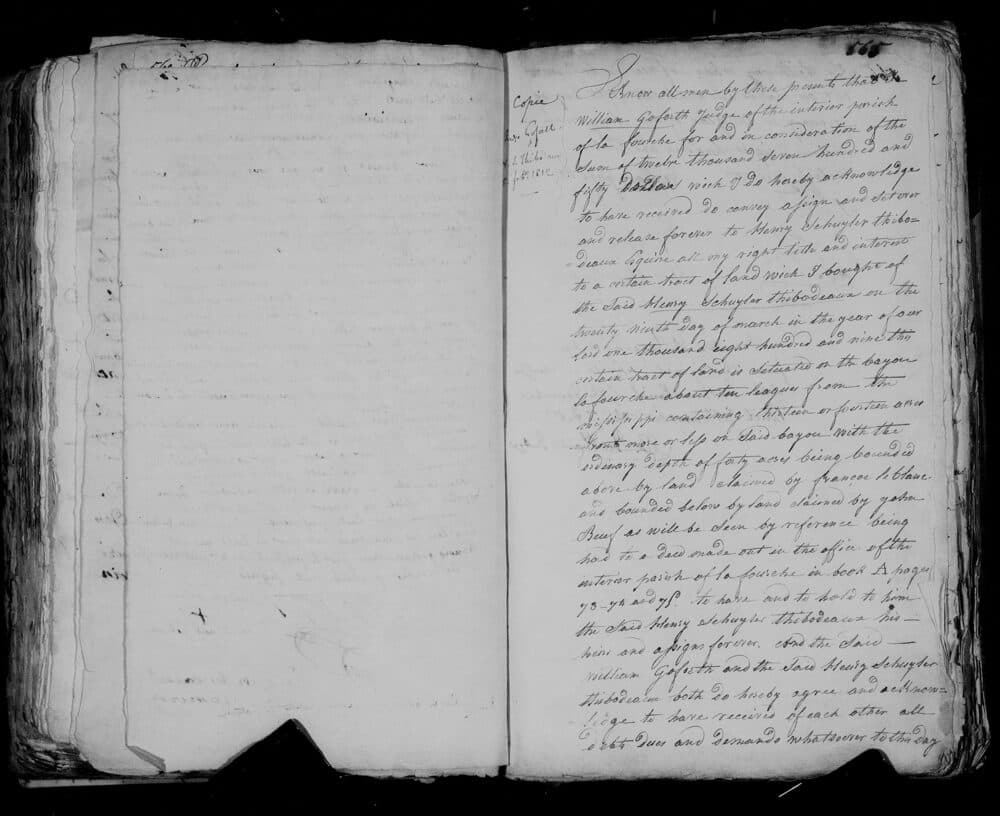
| 5 Feb 1812 | Deed, Goforth to Thibodaux, Assumption | Plantation reconveyed for $12,750; signed “H. S. Thibodaux” | Recorded copy, verified |
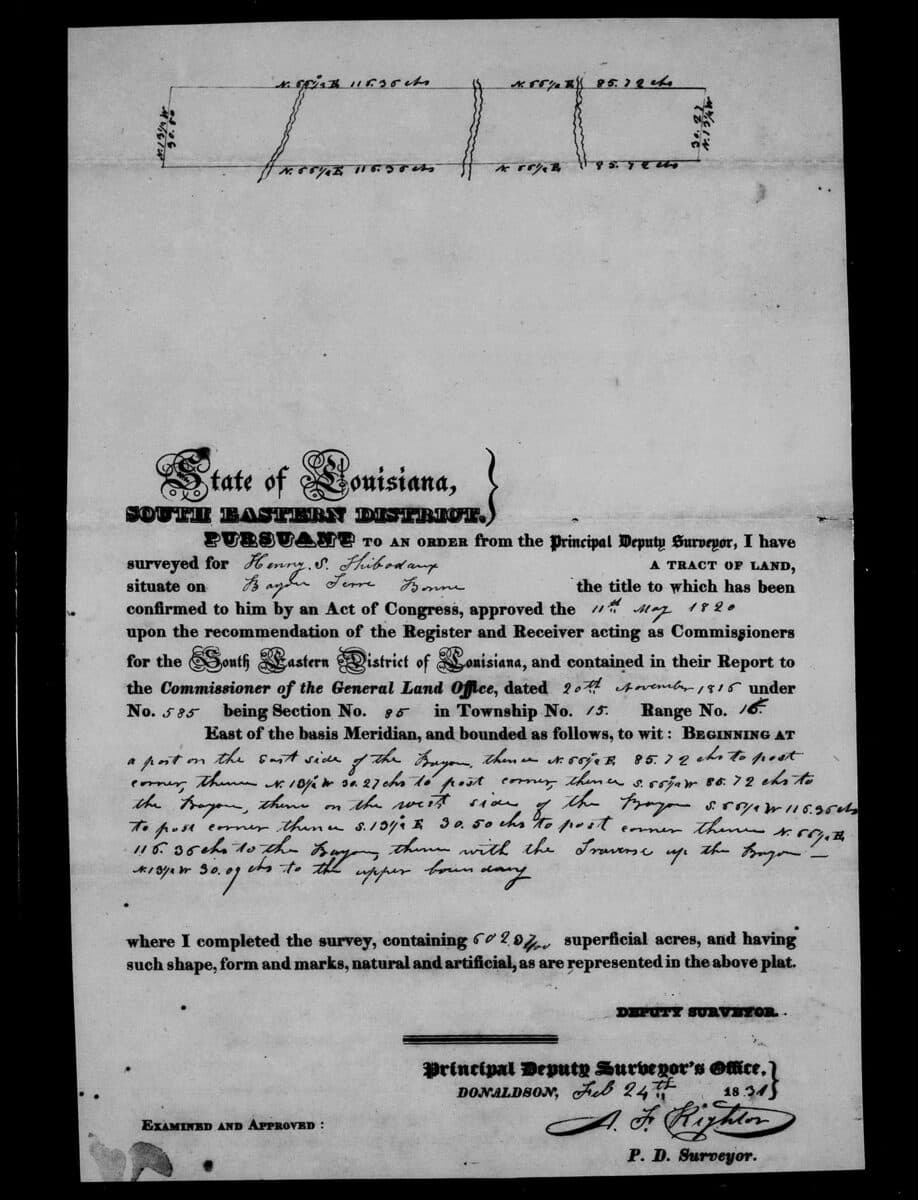
| 20 Nov 1816 | Land commissioners’ report, claim 585 | 602 acres on Bayou Terrebonne, settled by Spanish permission before Dec 1803 | Original, verified |
| 28 Jul 1817 | Olographic will, in English | Signed “Henry Scuyler Thibodaux”; practised medicine; names no parents or birthplace | Transcription; original ordered |
| 15 Nov–13 Dec 1824 | Acting governor of Louisiana | Published | |
| Oct 1827 | Death near Bayou Terrebonne | A false report of his death circulated before 20 Oct; the date 24 Oct still needs a primary source | Newspaper; pointer |
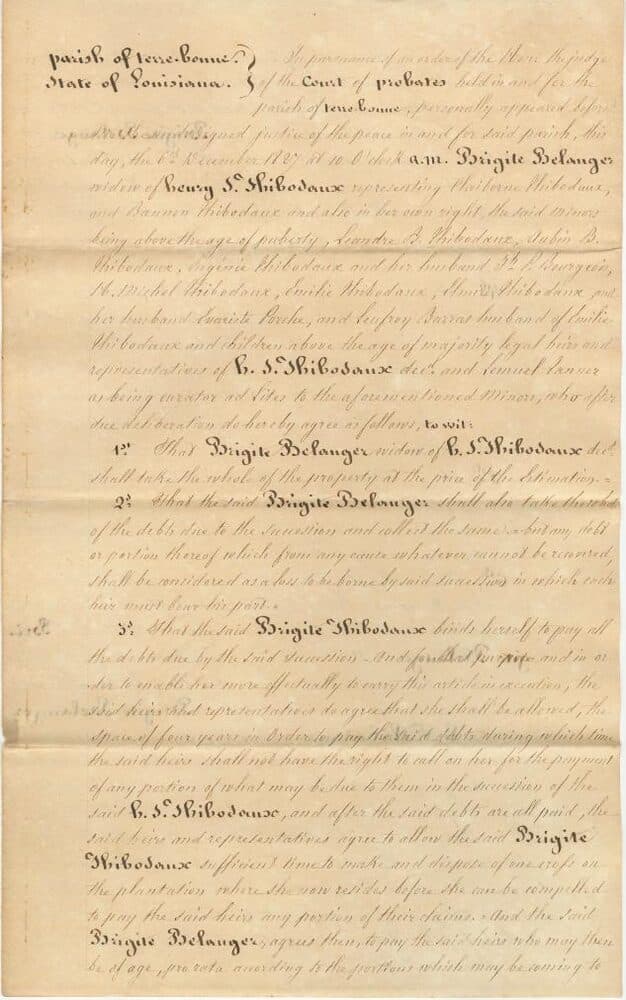
| 6–7 Dec 1827 | Family meeting, Terrebonne | Widow Brigitte and the heirs: Leandre, Aubin, Eugénie, Michel Henri, Émilie, Elmire, and the minors Claiborne and Bannon | Certified copy, verified |
| 24 Feb 1831 | Survey of claim 585 | The Terrebonne tract, both banks of the bayou below the town | Original, verified |
The people he held
Henry was a slaveholder, and his records name some of the people he enslaved. I will not leave them out. In March 1799 at Natchez a Henry Thebodeau bought David, a man of twenty-seven or twenty-eight, “healthy and sound except a bad cold which he catched on the water”, for $400, from two Kentucky boatmen, with a clause returning him if the Spanish government would not let the buyer keep him. That Henry is probably ours; he was the Baton Rouge garrison’s meat contractor and butcher in those years, buying cattle upriver, and no other Henry Thibodeau was in the district. David does not appear again in Henry’s records that we have read. In September 1799 a man the archive’s translator wrote as “Foretrech” was seized in Henry’s hands for the price of sixty-one cattle he had bought on credit, to be sold by order of the New Orleans tribunal. The 1809 inventory of the Lafourche plantation lists George, Margrete and Boue. The 1827 inventory, in a transcription, has a man of about fifty-five written “Diri”, whom I will check against the original when the succession file arrives. These are the names we have. The baptisms and burials that the Diocese of Baton Rouge holds for enslaved people of this period, which the printed abstracts leave out, may hold more.
The DNA
Here is the part that has moved the question most, and the part I can least verify myself, so I will be exact about what it is. A direct male-line descendant of Henry, with the line back to him confirmed by autosomal matching, took a Y-chromosome test at FamilyTreeDNA. The result, reported by the researcher who organised it and on the WikiTree Acadians Project page, is haplogroup R-CTS2457.2, a branch that is common in Ireland and Scotland and is not the signature carried by documented Acadian Thibodeau men. The tester had few Y matches and none close. The researcher’s summary: “Thibodaux wasn’t a Thibodeau.”
What that means, if it holds: the Y chromosome passes from father to son essentially unchanged, so every man in Henry’s male line should carry the Y of Henry’s biological father. If that Y is a branch found among Irish and Scottish men and not among Thibodeaus, then Henry’s father was not a Thibodeau by blood, whatever name Henry carried. It fits the shape of the documentary problem exactly: a man with a French Acadian surname, an English first name, an Albany middle name, born in New York, whose named parents cannot be his.
What it does not mean, yet. I have not seen the raw results or the tester’s pedigree. One tester, one line: a break anywhere in the five or six generations between Henry and the tester would give the same result and say nothing about Henry. “Irish or Scottish” is a population label for a haplogroup, not a surname; it narrows the field to a few million men of the 1760s, not to a family. And a single sample with no close matches cannot say who the father was, only who he was not. For all those reasons it stays in our files as a pointer only. It is a good pointer. For what it is worth, none of this touches my own Y line, which runs through the Bornes; Henry is my ancestor through his son Michel Henri and Michel’s son Claiborne, and then through a daughter.
Where we looked and found nothing
If Henry was born in New York, somebody should have baptized him. We searched the New York marriage licences to 1784, the New York City Dutch Reformed and Huguenot registers, Trinity Church online, the Albany church indexes, the Schuyler family finding aids, the Loyalist claims and the New York Acadian lists of 1756. Nothing. The Montréal notary’s books for 1787–90: no other act for Henry. The St. Louis cathedral registers 1787–92: nothing. Simon Thibodeau’s parish, notaries and estate at St-Denis: no Henri. FamilySearch’s full-text search across twenty spellings of the name: one Quebec lookalike, ruled out. The negative results are in the log, register by register, so that nobody has to read those books again.
What we did with the tree
On 19 October 2026, with my approval, Henry was detached from the Acadian parents in our working tree. His parents are now shown as unknown, and the note on his record gives the reasons. That cuts the Thibodaux line of my family off from five generations of Acadian ancestry that the trees had given it. The alternative was to leave a link in place that the records contradict, and that is not something I am willing to do in my own tree, let alone a client’s.
The method
A man’s own statement about himself is primary information for some things and secondary for others. Henry was a witness to his own name, his signature, his residence and his trade. He was not a witness to his own birth. What he knew about his parents he was told, and what he told the Cabildo may have been what he was told, what he believed, or what served him. We cannot tell which from his words alone; we can only test them against the other side’s records, and the other side’s records say no.
Three explanations remain. He named a different Alexis and Anne, a couple nobody has yet found in Canada or New York. He was raised by, or took the name of, a Thibodeau who was not his father, which is what the DNA points toward. Or he attached himself, as a young man alone in a new colony, to a well-known Acadian family name. The last is the one people enjoy, and I would caution against it: it is the hardest to prove and the easiest to say. This is an open case, not a debunking. Henry did not necessarily lie. His claim does not fit the records, and his origin is unsolved. It is also a reminder that a surname is a label, not a lineage, a point made at more length in why every surname is lying to you; if you descend from Henry and your DNA does not look Acadian, the test and the tree may both be right.
What it would take to pin him down
In order of how much each would settle, and how far along each one is.
- His succession file, Terrebonne Parish, 1827–29. Sixty-two pages, found by the clerk on 19 October 2026 and on order. It holds the original will and the inventory, including his papers, “bundles A to H”. A will written in his own hand in 1817 might say where he was born; the inventory names the enslaved people exactly.
- The Diocese of Baton Rouge register images for his 1793 and 1800 marriages and his children’s baptisms. The abstracts give the parents; the originals may give a birthplace, an age, a dispensation note, or a parish of origin the abstractor dropped. Request forms are ready.
- A handwriting match. The 1788 Montréal signature against the 1793, 1796 and 1798 Louisiana ones, by someone qualified. The capital T matches to my eye; the rest differs in style. A match would close the gap between the shoemaker and the senator.
- St. Peter’s Church, Albany, baptisms 1756–1775, on restricted film, readable at a FamilySearch centre. If he was baptized Anglican in Albany, this is where. The Dutch Reformed registers have already been read: no Thibodeau, no Blanchard.
- More Y-DNA. A second male-line descendant through a different son, to rule out a break below Henry; a Big Y-700 upgrade on the existing tester to place the branch precisely; and a watch on the match list for a surname. If two lines through two of Henry’s sons agree, the result is Henry’s, and the surname of the nearest match becomes the next search term. We do not contact testers or matches; that is my decision to make.
- The St. Charles lot and the Cerré papers. A deed or concession for the Main Street lot with his signature, or Cerré’s 1788–92 accounts at the Missouri Historical Society, would prove the Montréal and Missouri men are one, and would say where the brigade recruited him.
- The 1876 Deshields letter, in which Henry’s daughter is reported to have said that the Thibodeaux “were in no way related to us”. The original has not been seen. It is family hearsay two generations on, but it is the only statement from inside the family on the question, and it points the same way as the DNA.
What the papers prove
- In 1793 Henry stated, in a document he signed, that he was born in New York, the son of Alexis Thibodeau and Anne Blanchard, and had no relatives in the province.
- He swore to ages that put his birth at about 1765–1767.
- The Acadian Marie-Anne Blanchard, wife of Alexis Thibodeau, died before February 1762 and had no son Henri; the 1782 act counts her three living children.
- He was in St. James Parish by September 1792; was the Baton Rouge garrison’s meat contractor and a butcher 1799–1805; married there in 1800; held land on Bayou Lafourche by 1809 and on Bayou Terrebonne by Spanish permission before 1803; and died in Terrebonne in 1827 leaving a widow and eight heirs.
- The middle name Schuyler was in use by 1806–1809 and in his own will of 1817.
What isn’t proven yet
- Who his parents were, and where he was born.
- That the Montréal shoemaker of 1788, the St. Charles lot-owner of 1791 and the Natchez buyer of 1799 are him (strong candidates, each resting on name and circumstance).
- The Y-DNA result and what it implies about his father (pointer only; data not seen; one tester).
- Where the name Schuyler came from.
- His exact death date; the fates of David and the others he held.
Sources
- Información producida por Enrique Tibaudau para contraer matrimonio con Felicité Mirre, 14–15 Jan 1793, no. 1250 (WPA 2963), Spanish Cabildo judicial records, Louisiana Historical Center, Louisiana State Museum; images, FamilySearch DGS 8452163, images 315–321.
- Records of the Diocese of Louisiana and the Floridas, IV-5-l (Plaquemine, 14 Oct 1796, no. 238) and V-1-i (New Orleans, 9 Jul 1798, no. 154), University of Notre Dame Archives; images 5.761–766 and 7.630–637.
- Engagement of Henry Thybaudau to Gabriel Cerré, 14 May 1788, P.-R. Gagnier, notary, Montréal, minutes 1787–1790; BAnQ, via FamilySearch DGS 5155316, image 119.
- Inventory of Jean-Baptiste Grizard, St. Charles, 18 Nov 1791, recorded copy 1847; St. Louis City archives records, FamilySearch film 007513789, images 253–255.
- Adams County, Mississippi, Deed Book B, p. 14 (16 Mar 1799); FamilySearch DGS 8201489, image 204.
- Archives of the Spanish Government of West Florida (WPA translation), vol. 3 p. 70 (28 May 1799), vol. 4 pp. 8 and 264 (1799–1800), vol. 5 p. 52 (1801), 1803–07 vol. p. 273 (1805); NARA T1116; images, Ancestry collection 2454.
- Assumption Parish conveyances, Cahier 5, pp. 565–566 (5 Feb 1812); FamilySearch DGS 8696694.
- U.S. Land Office, New Orleans, Register and Receiver’s report, 20 Nov 1816, p. 95, claim 585 (Louisiana Office of State Lands, doc. 510.00371); survey of claim 585, A. F. Rightor, 24 Feb 1831, South-eastern District claim papers, FamilySearch DGS 8545088, image 778.
- Family meeting on the succession of H. S. Thibodaux, 6–7 Dec 1827, certified copy 1836, Nathaniel Evans and Family Papers, LSU; Records of Ante-Bellum Southern Plantations, FamilySearch DGS 8945001, images 345–352.
- Diocese of Baton Rouge, Catholic Church Records, vols. 2–3 (St. James, Ascension and Baton Rouge abstracts 1792–1816); Terrebonne conveyance abstracts (acts 484, 516, 670).
- Quebec notarial act of 4 Mar 1782 (Alexis Thibodeau × Catherine Le Blanc to their son Joseph), FamilySearch 3QHV-R32M-N6Z9; Massachusetts State Archives, vol. 24, pp. 557–559 (Acadian family list); the St-Denis records of Simon Thibodeau, 1775–1819; Stephen A. White, Dictionnaire généalogique des familles acadiennes, with the 2003 and 2011 corrections.
- Savanna King, The Rabbit Hole (Substack), “An update: Henry Schuyler Thibodaux’s Y results” (13 Jan 2026) and “The shoemaker of Terrebonne” (31 Mar 2026); WikiTree, Acadians Project, profile Thibodaux-22. Pointers only.
- Wendy Pitre Roostan, “Origins of Henry Schuyler Thibodaux” (Pitre Trail, 2010), for the Louisiana abstracts and the 1827 inventory transcription.
- Full citations are in the research file for Henry Schuyler Thibodaux and the research plan of 18 October 2026.
Image credits
- U.S. Geological Survey, Thibodaux sheet, 1:62,500, 1890 (detail). Perry-Castañeda Library Map Collection, University of Texas, via Wikimedia Commons, Public domain.
- Portrait of Henry Schuyler Thibodaux. Louisiana State Museum, via Wikimedia Commons, Public domain.
- Marriage petition of Enrique Tibaudau, 1793, folio 1 (Cabildo judicial records no. 1250). Louisiana Historical Center, Louisiana State Museum; image via FamilySearch, Public record, reproduced for research.
- Signatures of Henrey Thibodaux, 1796 and 1798, marriage dispensation files IV-5-l and V-1-i. University of Notre Dame Archives, Public record, reproduced for research.
- Engagement of Henry Thybaudau, Montréal, 14 May 1788, and detail of its margin (P.-R. Gagnier, notary). Bibliothèque et Archives nationales du Québec; image via FamilySearch, Public record, reproduced for research.
- Inventory of Jean-Baptiste Grizard, St. Charles, 1791, recorded copy 1847 (detail). St. Louis City archives records; image via FamilySearch, Public record, reproduced for research.
- Bill of sale, Waters and Harrison to Henry Thebodeau, Natchez, 1799 (detail), Adams County Deed Book B. Adams County Chancery Clerk, Natchez; image via FamilySearch, Public record, reproduced for research.
- Deed, William Goforth to Henry Schuyler Thibodeaux, 1812, Assumption Parish conveyances, Cahier 5. Assumption Parish Clerk of Court; image via FamilySearch, Public record, reproduced for research.
- Survey and plat of claim No. 585, Henry S. Thibodaux, 1831. Louisiana Division of State Lands; image via FamilySearch, Public record, reproduced for research.
- Family meeting on the succession of H. S. Thibodaux, 1827, certified copy 1836, page 1. Nathaniel Evans and Family Papers, Louisiana State University; image via FamilySearch, Public record, reproduced for research.