
Blog ·
Twelve children, few who grew up
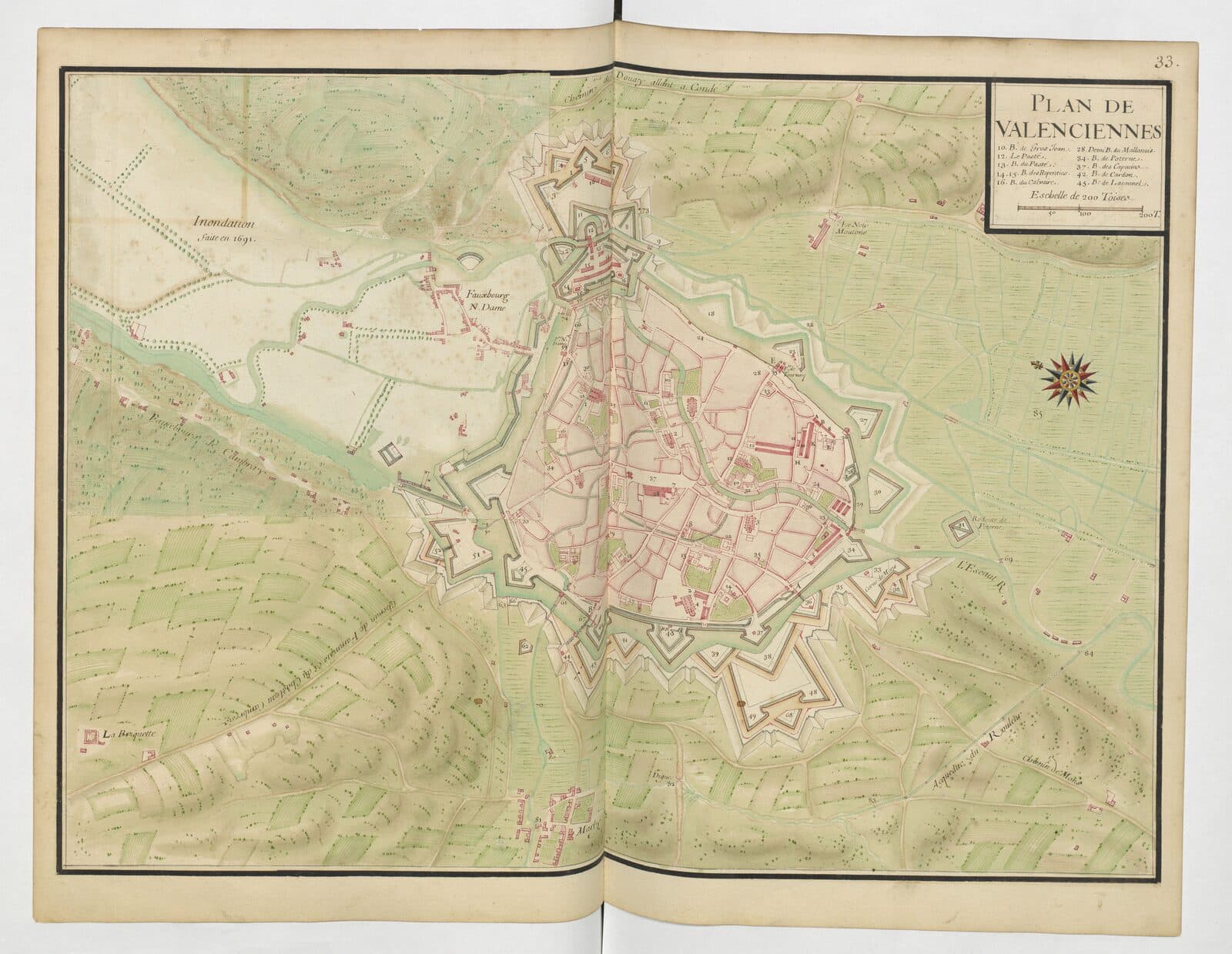
The first version of my family presentation had a slide about Michel LeBorne of Valenciennes, my 8×-great-grandfather. It said he had ten children and one survivor: only Jacques Antoine, the boy who went to Louisiana in 1718, lived to grow up. It said Michel married three times. It said the brewer Jean Claude LeBorne of Cambrai was a half-brother from an earlier marriage. All three statements were wrong, and I am going to show you how, because the way they were wrong is more useful than the way they were corrected.
The family as the registers give it
Michel LeBorne married Marie Jeanne Manart at the church of St-Martin in Cambrai on 4 February 1687. Not “about 1693” in Valenciennes, as the tree had it: Cambrai, thirty kilometres away, six years earlier. Their first two children were baptized at St-Nicolas in Cambrai, Jean Claude on 30 October 1687 and Marie Joseph on 2 January 1689. Then the family moved. From 1694 to 1707 ten more children were baptized at Notre-Dame-de-la-Chaussée in Valenciennes, including Jacques Antoine on 15 May 1697 and a pair of twins in July 1705.
| Child | Baptized | Parish | Fate |
|---|---|---|---|
| Jean Claude | 30 Oct 1687 | St-Nicolas, Cambrai | Master brewer, Cambrai; died 1747 aged 60 |
| Marie Joseph | 2 Jan 1689 | St-Nicolas, Cambrai | Not living in 1707 |
| Marie Françoise | 16 Apr 1694 | ND-de-la-Chaussée, Valenciennes | Not living in 1707 |
| Jean Gabriel | 12 Aug 1695 | ND-de-la-Chaussée | Not living in 1707 |
| Jacques Antoine | 15 May 1697 | ND-de-la-Chaussée | To Louisiana, 1718; my ancestor |
| Marguerite | 16 Jun 1699 | ND-de-la-Chaussée | Living 1707 and 1733 |
| Jean François | 4 Mar 1701 | ND-de-la-Chaussée | Not living in 1707 |
| Jean François | 27 Jul 1702 | ND-de-la-Chaussée | Not living in 1707 |
| Jean Baptiste | 10 May 1704 | ND-de-la-Chaussée | Not living in 1707 |
| Jean François Joseph (twin) | 27 Jul 1705 | ND-de-la-Chaussée | Not living in 1707 |
| Marie Françoise Joseph (twin) | 27 Jul 1705 | ND-de-la-Chaussée | Not living in 1707 |
| Jean Baptiste | 2 Mar 1707 | ND-de-la-Chaussée | Living Sep 1707, aged 7 months |
Look at the names. Three boys called Jean François, two called Jean Baptiste, two girls called Marie Françoise. Families in this period reused a name when the child who first carried it had died, so the repeats are themselves evidence of deaths we have no burial record for. Twelve baptisms in twenty years, and most of those children did not see their fifth birthday.
The White Glove, rue des Goblets
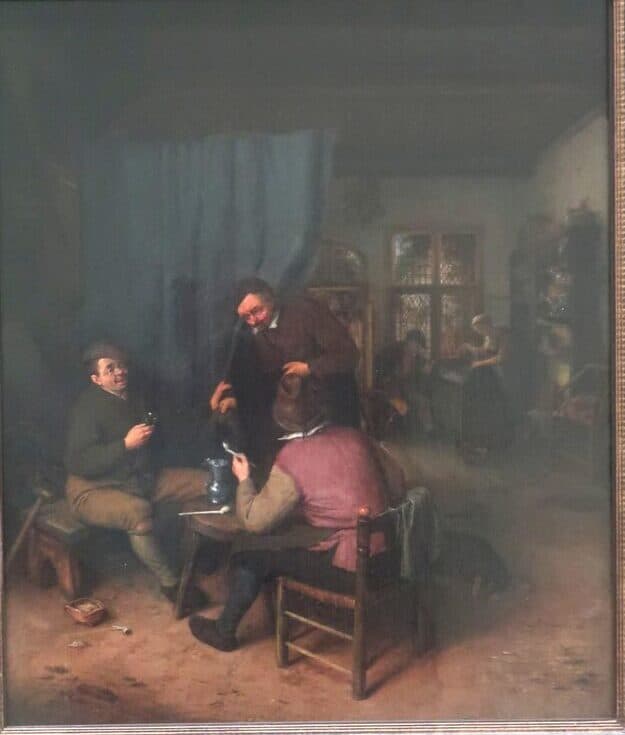
Marie Jeanne Manart was buried on 12 April 1707 at Notre-Dame-de-la-Chaussée, recorded as “femme à Michel Leborne, au Blan Gand, rue des Gobletz”: the wife of Michel Leborne, at the White Glove, rue des Goblets. Michel was a cabaretier, a tavern keeper, and the White Glove was his tavern. The house belonged to the heirs of a merchant named Delanglet, and when they divided the estate in December 1712 the inventory lists it, occupied by “la veuve Michel le Borne”, valued at 165 livres of rent, and passing to a new owner from Christmas that year. That is where the name of this company comes from, and it is one of the few things about Michel I did not have to correct.
Four children living, September 1707
Five months after burying his wife, Michel signed a marriage contract with his second wife, Claire Leducq, on 12 September 1707. French marriage contracts of this period, when one party is a widower, list his children by a previous marriage so that their inheritance can be protected, and this one does. The four living children were Jean Claude, 21 (really about 20), Jacques Antoine, 10 to 11, Marguerite, about 10, and Jean Baptiste, seven months. No relative stood with Michel at the signing. A friend did, Catherine Bonbled, widow of Jean Delrue, “sa commère et bonne amie”, and the contract names her as guardian of the children should he die.
He did, within five years. Michel was buried on 11 January 1712, a second-class funeral, “Michel Leborne, Blan Gand, rue des Goblets”, with no age and no parents recorded. And in January 1713, when the contract was finally registered, it was Catherine Bonbled, not a LeBorne uncle or grandparent, who accepted the guardianship of his minor children. There was, so far as the records show, no LeBorne relative in Valenciennes to do it.
Who grew up
Three of the four did. Jean Claude went back to the city of his birth and became a master brewer in Cambrai; he died there on 17 December 1747, “aged sixty”, which fits a baptism in October 1687 exactly. Jacques Antoine went to Louisiana in 1718 and founded my line there. Marguerite was still alive in 1733, when her stepmother Claire Leducq made her will and left a legacy to “sa belle-fille Marguerite le Borne”. Only the infant Jean Baptiste drops out of sight. So not one survivor: three, two of whom we can follow into middle age.
How the errors happened
The whole false structure grew from one date. An earlier researcher had estimated Jean Claude’s birth as 1686. That put him before the 1687 marriage, so he could not be Marie Jeanne Manart’s son, so Michel must have had an earlier wife, so Jean Claude was a half-brother, so Michel married three times. Each step followed from the last and none of them was checked against a record, because the record that would have checked them, Jean Claude’s baptism, had not been found. When it was found, on 1 October 2026, in the St-Nicolas register at Cambrai, it named his parents as Michel Leborne and Marie Jeanne Manart. The first wife, the three marriages and the half-brother all fell away in a single afternoon.
The “one survivor” error was a different kind. Nobody had read the 1707 marriage contract or the 1733 will. The tree had no deaths for most of the children, and it is easy to slide from “no death recorded” to “died” to “all died but the one we can follow”. The contract lists four living children by name and age. The will names a stepdaughter. Both are originals from the municipal archives in Valenciennes, scanned and sent to us in October 2026, and neither is subtle. They simply had not been looked at.
Keep your mistakes on file
Here is the practice I want to recommend. When a hypothesis is withdrawn, it stays in the research log, struck through, with the date and the reason. Michel’s profile still says “first wife before about 1686” and “three marriages”, each crossed out, each followed by “both rested on Jean Claude’s assumed 1686 birth”. The presentation was corrected on 5 October 2026 and the README for it lists every slide that changed and why.
This is not self-flagellation. It is the only way to stop a dead idea coming back. Somebody, possibly you, will one day find a Michel Le Borgne with a different wife in a Cambrai register and think they have found the missing first marriage. The struck-through line tells them it was considered, and why it was dropped. Online trees have no such mechanism, which is one reason a wrong date can survive in them for decades: there is no record that it was ever doubted. Correcting yourself in public is not a failure of the standard. It is the standard. The Genealogical Proof Standard asks for resolution of conflicting evidence and a written conclusion, and a written conclusion that cannot be revised is not a conclusion, it is a creed.
As for how a family of twelve ends up with three adults, that is the ordinary demography of a seventeenth-century town, and it is why the arithmetic in how many ancestors you actually have works the way it does. Most lines died out. Michel’s came within one tavern keeper’s daughter and two sons of doing the same.
What the papers prove
- Michel LeBorne married Marie Jeanne Manart at St-Martin, Cambrai, on 4 February 1687.
- Twelve children were baptized to them: two at Cambrai (1687, 1689) and ten at Valenciennes (1694–1707).
- Jean Claude, the Cambrai brewer, was Marie Jeanne’s son, not a half-brother.
- Four children were living on 12 September 1707: Jean Claude, Jacques Antoine, Marguerite and Jean Baptiste.
- Marguerite was living in April 1733.
- Michel kept the Gant Blanc tavern on the rue des Goblets and was buried 11 January 1712.
What isn’t proven yet
- Michel’s parents and birthplace. That is the next post.
- What became of the infant Jean Baptiste after September 1707.
- Two “Jean Jacques Borne, b. 1708” in the inherited tree match no baptism and are marked for removal.
Sources
- Archives départementales du Nord, Cambrai, St-Martin marriages (4 Feb 1687) and St-Nicolas baptisms (30 Oct 1687, 2 Jan 1689); online registers.
- Archives départementales du Nord, Valenciennes, Notre-Dame-de-la-Chaussée, baptisms, marriages and burials 1694–1712, 5 Mi 055 R 001 (baptisms 1694–1711; burials 12 Apr 1707 and 11 Jan 1712; marriage 27 Sep 1707).
- Archives municipales et communautaires de Valenciennes, Fonds Caffiaux (VAL II 2): cote 3480, marriage contract of Michel le Borgne and Claire le Ducq, 12 Sep 1707, registered 9 Jan 1713; cote 3822, partition of the estate of Abraham Delanglet, 16 Dec 1712; cote 5162, will of Jeanne Claire le Ducq, widow of Michel le Borne, 9 Apr 1733. Scans supplied by the archives, 9 Oct 2026.
- Archives départementales du Nord, Cambrai, burials: Jean Claude Leborne, 17–18 Dec 1747.
- Full citations are in the research files for Michel LeBorne, Marie Jeanne Manart, Jean Claude LeBorne and Claire Leducq.
Image credits
- Plan de Valenciennes, manuscript plan, 1693. Bibliothèque nationale de France (Gallica), via Wikimedia Commons, Public domain.
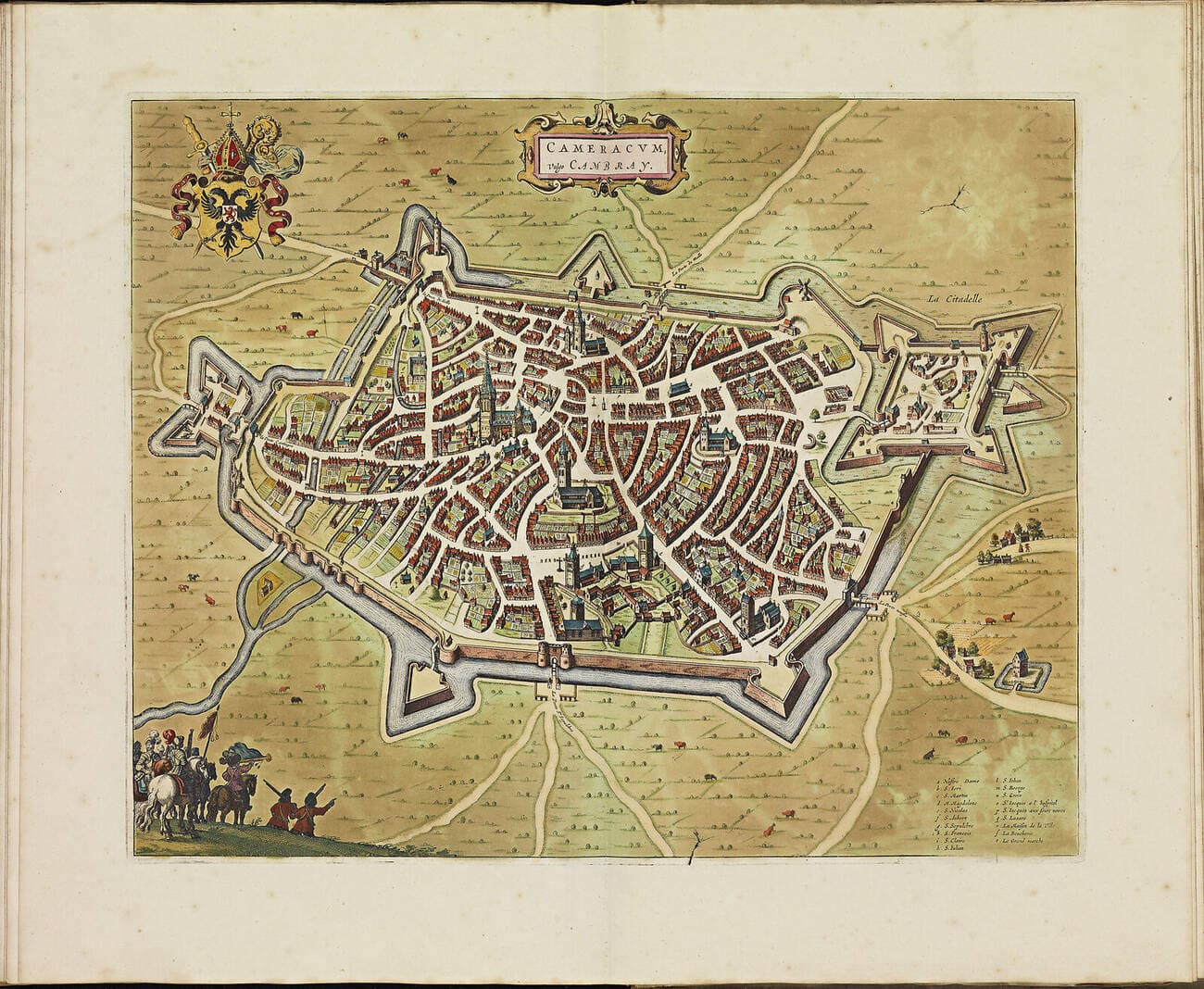
- Frederik de Wit, Cameracum vulgo Cambray, c. 1698, from the Atlas de Wit. Koninklijke Bibliotheek, via Wikimedia Commons, Public domain.
- Adriaen van Ostade, Customers Conversing in a Tavern, 1671, oil on panel (detail). Wikimedia Commons, CC0.