
Blog ·
Wills, lawsuits and inventories: the records that name the family
Baptisms say who your parents were. Estates say who everyone else was. When the parish registers are lost, as they are for St. Charles Parish, the courts often kept the family together on paper, and Louisiana’s civil-law successions are especially good at it: every heir has to be named, every minor needs a tutor, and the file sometimes carries copies of records that survive nowhere else. Three files from my own tree, and what each one proved.
A. One sentence, three generations
Alphonse Perret, a planter of St. Charles Parish, made his will in New Orleans before the notary Christoval de Armas in January 1818, a few weeks before he died. In it he provided for “Benjamin Borne, mineur, mon petit fils, fils légitime de Benjamin Borne et de feue dame Marianne Perret ma fille légitime”: Benjamin Borne, a minor, my grandson, legitimate son of Benjamin Borne and of the late Mrs Marianne Perret, my legitimate daughter.
Read that sentence as a genealogist and it does four things at once. It names three generations in a direct line, Alphonse to Marianne to the boy Benjamin. It states that Marianne was dead by January 1818. It states that her husband was alive. And it identifies the grandson as a minor, which fits a boy born in 1808 and rules out his father, also baptized Antoine Benjamin, who was then nearly forty. Marianne’s own baptism burned with the St. Charles registers. The will does not care. It was written by a man who knew exactly who his daughter and grandson were, and signed in front of a notary whose job was to make sure the words would hold up in court.
B. The succession that proves a parentage and gives an age
That minor grandson grew up to be my 3×-great-grandfather, and he died at Algiers on 28 June 1848, aged forty. His succession, No. 2556 in the First District Court of New Orleans, was opened by his widow, Marie Augustine Latour, in July. Her first petition lists the minor children with their ages: Benjamin 14, Estelle 9, Pierre Théophile 7, Jean Félix 5, Joseph René 3. A married daughter, Odile, was written into the list and struck out as being of age.
That petition is the document that proves the parentage of Jean Félix Borne, the Confederate ship carpenter of the first post in this series, and it is also his best birth estimate. His records later in life give his birth year as anything from 1844 to 1847. His mother, sworn in July 1848, said he was five. She was the one person alive who could not get it wrong by much, and I take 1843 from her over every census taker who came after.
The file records the estate too, and the estate was small: a bedstead, an armoire, twelve silver spoons and forks, a large silver spoon, no land, and four people. Their names were Victor, Sam, Silvie, and Silvie’s daughter Louise. They were enslaved by my ancestor, inventoried at his house in Algiers on 21 July 1848 as part of a total of $1,833, and sold on 10 October 1848 to settle his affairs. The succession names them because they were property in the eyes of that court. I name them here because they were people, and because a family history that lists the silver spoons and skips the four human beings on the same page is not a history.
C. A sister’s estate that carried her brother’s baptism
Go back three more generations. Geneviève Bettemont, widow of the Louisiana immigrant Jacques Antoine LeBorne, died on her plantation on the German Coast in the autumn of 1784, and on 25 November the commandant of St. Charles des Allemands inventoried her estate. The heirs who swore to it were her son Antoine, my ancestor, and her daughter Geneviève Marguerite, widow of François Castant.
Geneviève Marguerite did not outlive her mother by long. She died between 3 December 1784 and 12 April 1785, when her own succession was opened in New Orleans, and because she died without children her heirs were her brother Antoine and her sister Marguerite, by then Mrs Verret. That file, in the Louisiana Historical Center, is one of the best things we have found. To establish who the heirs were, the court had the St. Charles priest certify extracts of the family’s baptisms, and those extracts are in the file: Geneviève Marguerite’s of 1735, Antoine’s of 1737, Marguerite’s of 1743. The original St. Charles register burned. The certified extracts made in April 1785 did not. Antoine’s extract, incidentally, gives his birth as 22 June 1737 and corrects a 22 January that had crept into the tree.
The same file holds a copy of Geneviève Marguerite’s 1754 marriage contract with François Castant dit Toulouze, in which she is described as the minor daughter of Jacques Antoine Leborne and Geneviève Bettemont, native of the Allemands. One sister’s estate, then, proves the parentage of all three siblings and preserves three baptisms that no longer exist anywhere else.
The contract that survived as an exhibit
One more, because it shows how records hide inside other records. The marriage contract of Antoine Benjamin Borne and Marie Augustine Latour, signed at St. Charles on 7 July 1830, survives only because it was filed as an exhibit in a later lawsuit: suit No. 1906, a separation of property between the same couple, in 1848. We found it by reading that suit. It is the record that showed the groom’s father, Benjamin LeBorne, alive and living in Ascension Parish in July 1830, and killed a death date of 1829 that had been sitting unsourced in an online tree, as the post on how online trees invent ancestors describes.
The method
Probate and court records are where indirect relationships become direct. A godparent at a font suggests kinship; an heir in a succession is kinship, stated under oath, in a document the other heirs could contest and did not. So search for the estates of every relative, not only your direct ancestor. A sibling’s succession names the siblings. A parent’s names the children, wherever they have gone. An aunt’s, as here, may name the whole family and attach their baptisms for good measure.
And read the whole file, not the index. The Louisiana Historical Center’s calendar card for the 1785 succession is a typed twentieth-century summary, a few lines long. It does not mention the baptism extracts. The extracts are on images 33 to 41 of the file, and the only way to know they were there was to open it. The same is true of suit No. 1906: no index says “contains the 1830 marriage contract”. An exhibit is only findable by someone who reads exhibits.
A limit, to keep the standard honest. Not every relationship in these files is stated. Pouponne Darensbourg’s brothers Adolphe and Charles are known to be her brothers because of how their estates were divided in 1831 and 1845, among sibling lines, with her children taking her share. No document in either file says “brother”. That is an inference from the shape of a division, and it is a good one, and it is still an inference. The profile says so.
What the papers prove
- Marianne Perret was the daughter of Alphonse Perret, the wife of Benjamin Borne, and dead by January 1818; their son Benjamin was a minor (Perret’s will, 1818).
- Jean Félix Borne was the son of Antoine Benjamin Borne and Marie Augustine Latour, aged five in July 1848 (succession No. 2556).
- Victor, Sam, Silvie and Louise were enslaved in that household and sold on 10 October 1848.
- Geneviève Marguerite, Antoine and Marguerite LeBorne were the children of Jacques Antoine LeBorne and Geneviève Bettemont, by certified baptism extracts of 1785 and the 1754 marriage contract.
- Benjamin LeBorne was alive in Ascension Parish on 7 July 1830 (marriage contract, exhibit in suit No. 1906).
What isn’t proven yet
- That Adolphe and Charles Darensbourg were Pouponne’s brothers: inferred from the division of their estates, not stated.
- The names of the two people enslaved in Benjamin LeBorne’s 1831 inventory, not yet transcribed from the page.
- Alphonse Perret’s own succession, which should exist in St. Charles or Orleans and has not been found.
Sources
- Will of Alphonse Perret, of the parish of St. Charles, passed before Christoval de Armas, notary, New Orleans, 21 Jan 1818; Orleans Parish Will Books 1817–1824, p. 44 and image 60; images, FamilySearch.
- Succession of Antoine Benjamin Borne, No. 2556, First District Court, Orleans Parish, 1848; images 519–590 of the Orleans Parish succession files, FamilySearch. Opening petition with the children’s ages, image 519; inventory of 21 Jul 1848; sale of 10 Oct 1848.
- Suit No. 1906, First District Court, Orleans Parish, 1848 (separation of property, Marie Augustine Latour v. Antoine Benjamin Borne), with the marriage contract of 7 Jul 1830 as an exhibit; FamilySearch DGS 007670423, image 1323.
- Louisiana Historical Center, Louisiana State Museum, Spanish Judicial Records: succession of Geneviève Le Borne, widow Castant, 1785-04-12-02 (Doc. 1046, Box 43, File 2985), with the certified baptism extracts (images 33–41) and the 1754 marriage contract (images 17–26); and 1798-08-06-01, with the 1784 inventory of Geneviève Bettemont’s estate (folio 23 and the Spanish translation, images 115–116); online at lacolonialdocs.org.
- Successions of Adolphe Darensbourg (1831–32) and Charles Darensbourg (1845), and the partition of the community of André Latour and Pouponne Darensbourg, 20 Mar 1834.
- Full citations are in the research files for Alphonse Perret, Marianne Perret, Antoine Benjamin Borne, Geneviève Bettemont, Geneviève Marguerite LeBorne and Pouponne Darensbourg.
Image credits
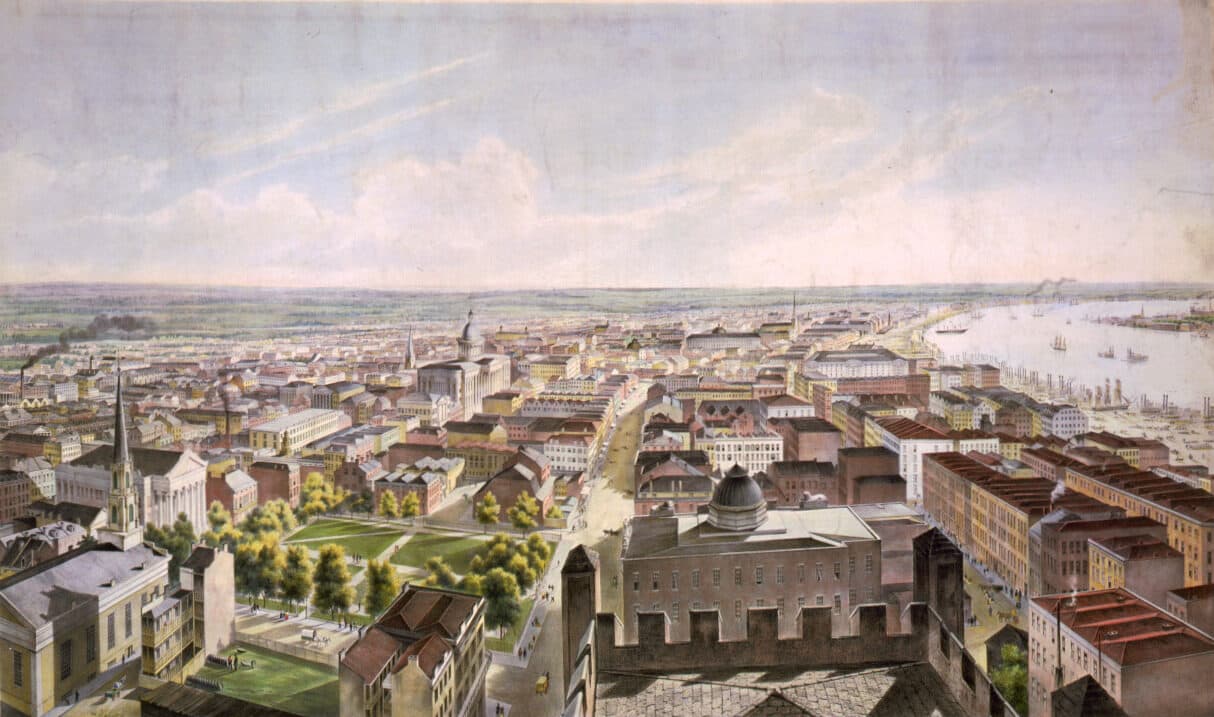
- J. W. Hill and Smith, New Orleans, lithograph, 1852. Wikimedia Commons, Public domain.
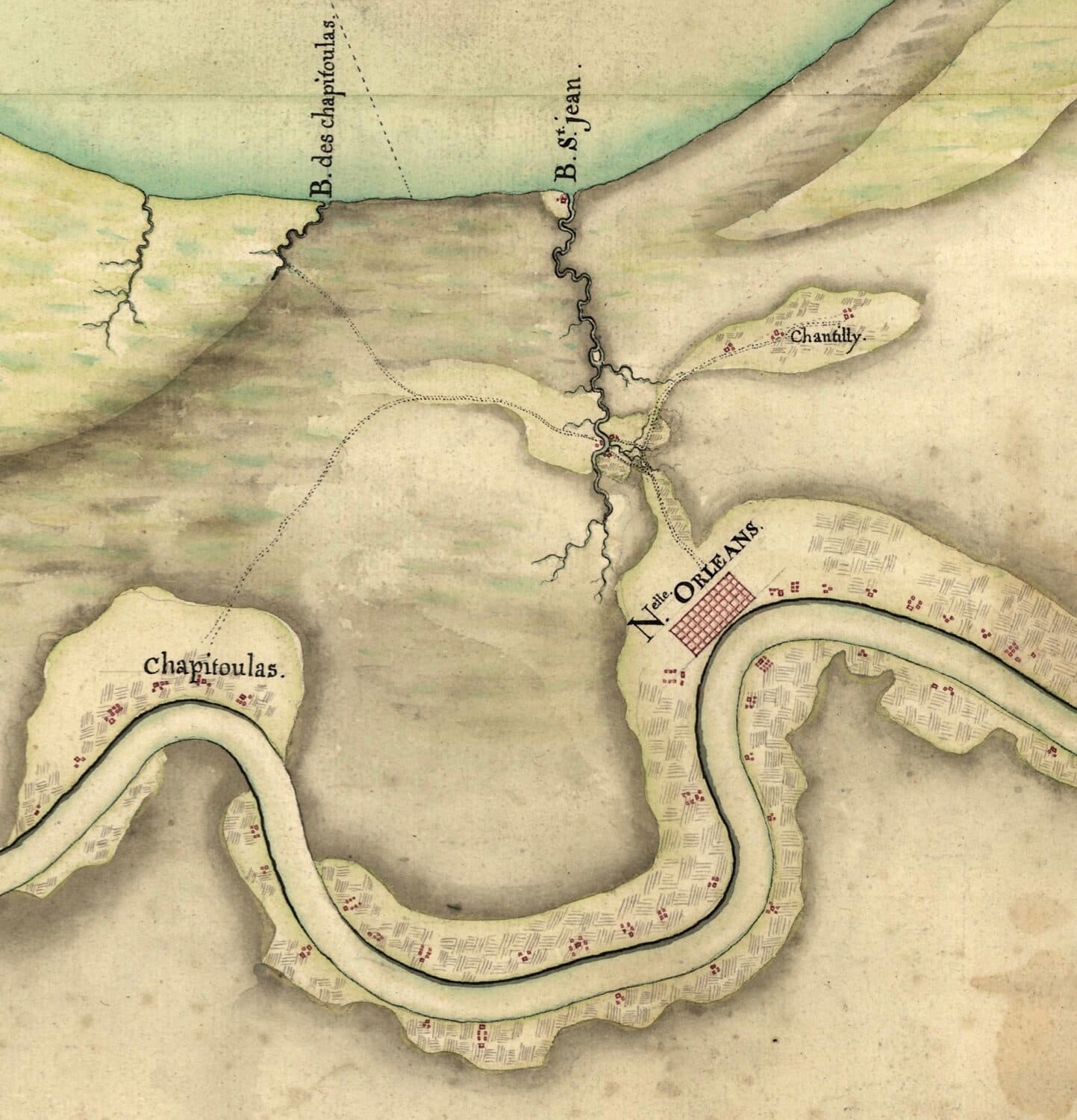
- The Cabildo, 711 Chartres Street, New Orleans, Orleans Alley elevation, June 1936 (HABS LA,36-NEWOR,4-9). Historic American Buildings Survey, Library of Congress, via Wikimedia Commons, Public domain (U.S. government work).
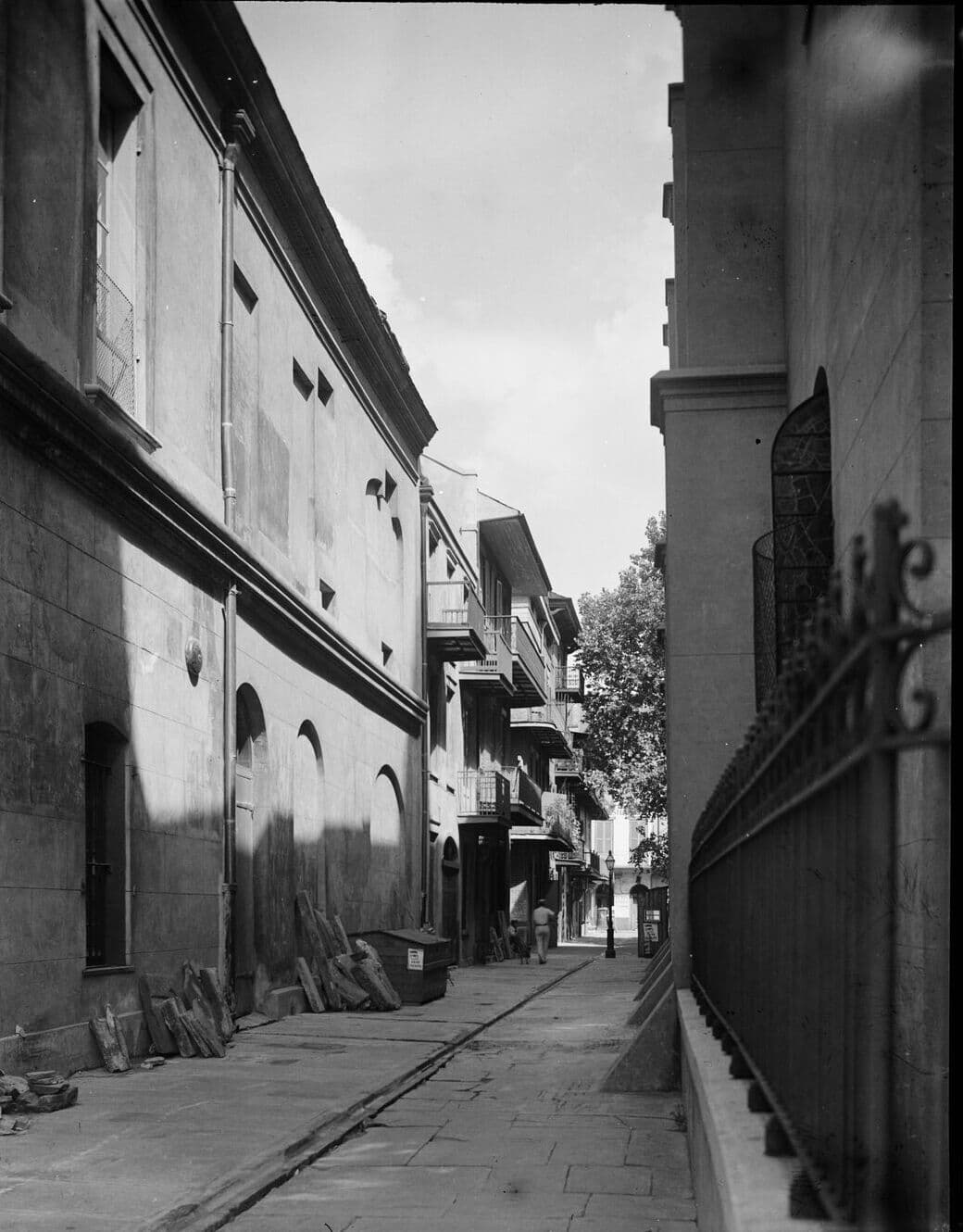
- F. Sacier, plan of New Orleans and surroundings, 1749. Wikimedia Commons, Public domain.
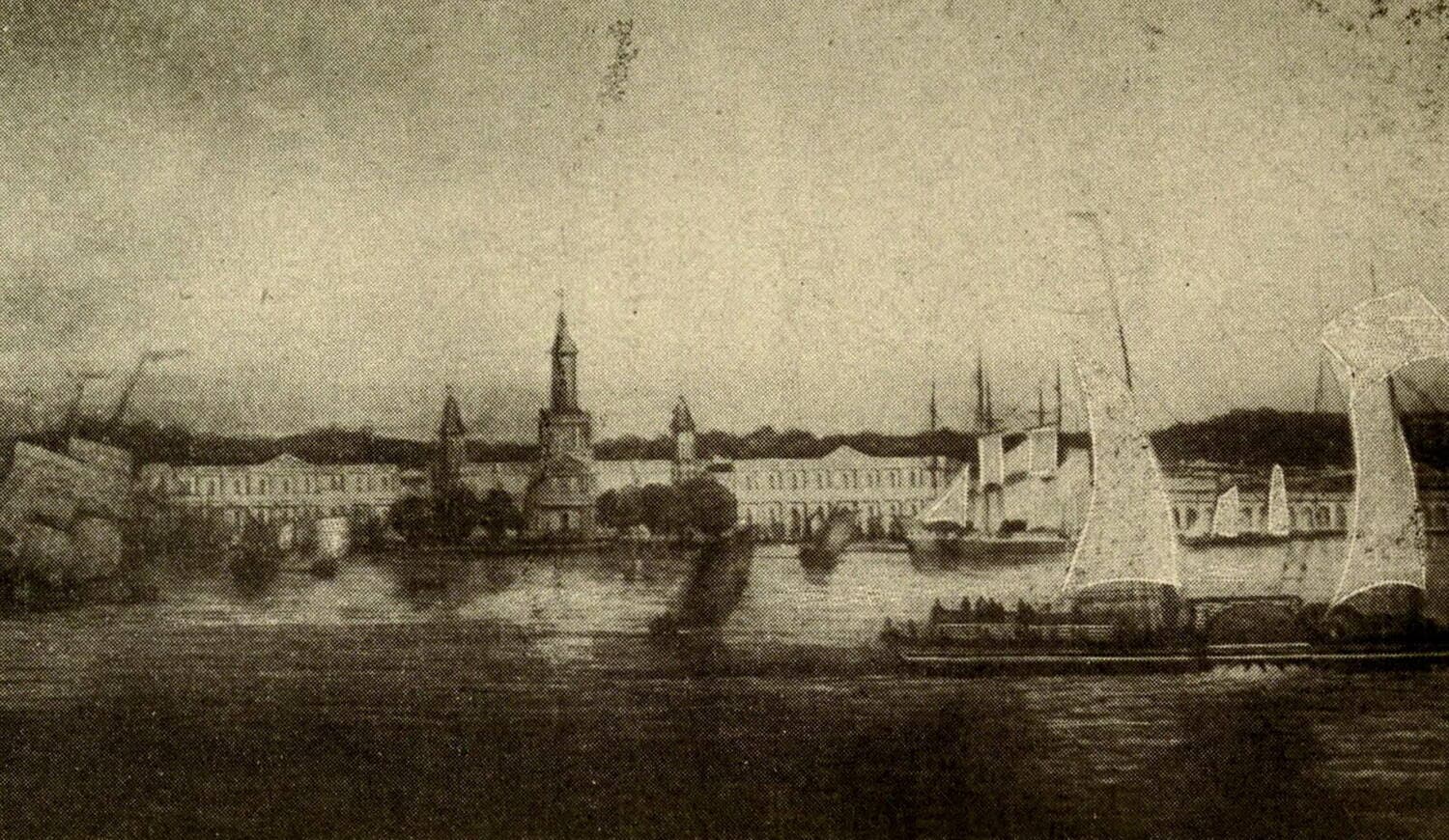
- Jackson Square (Place d’Armes) from the river, c. 1840. Wikimedia Commons, Public domain.