
Blog ·
Pedigree collapse: why you don’t have a billion ancestors
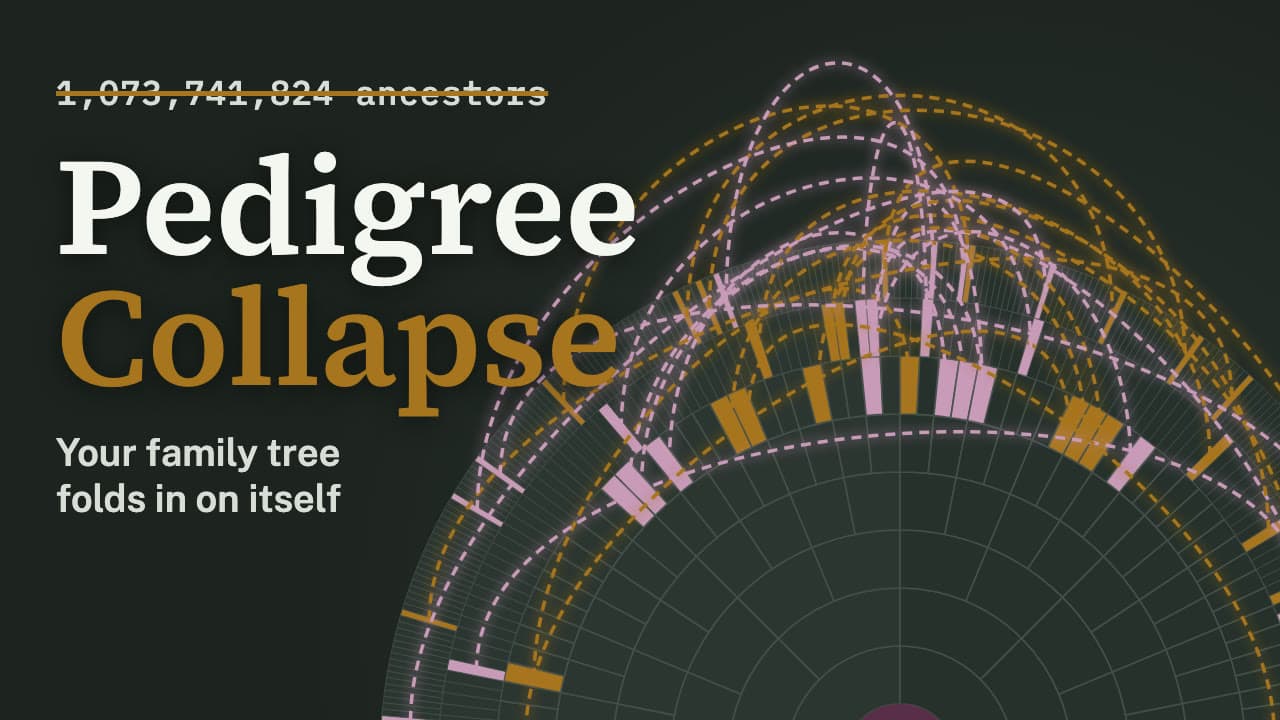
Go back thirty generations and your family tree needs more than a billion ancestors, in a year when the whole world held perhaps 300 million people. This short video shows why that number is impossible, what happens instead, and why the answer makes your ancestry wider rather than narrower.
Chapters
- 0:00The doubling
- 0:22The wall: more ancestors than people
- 0:50Pedigree collapse
- 1:26Greece: cousins on purpose
- 2:04Rome and Egypt
- 2:42The medieval village
- 3:25The curve: a simulation
- 3:53Everyone or no one
- 4:36Where the paper runs out
- 5:09The middle distance
The wall
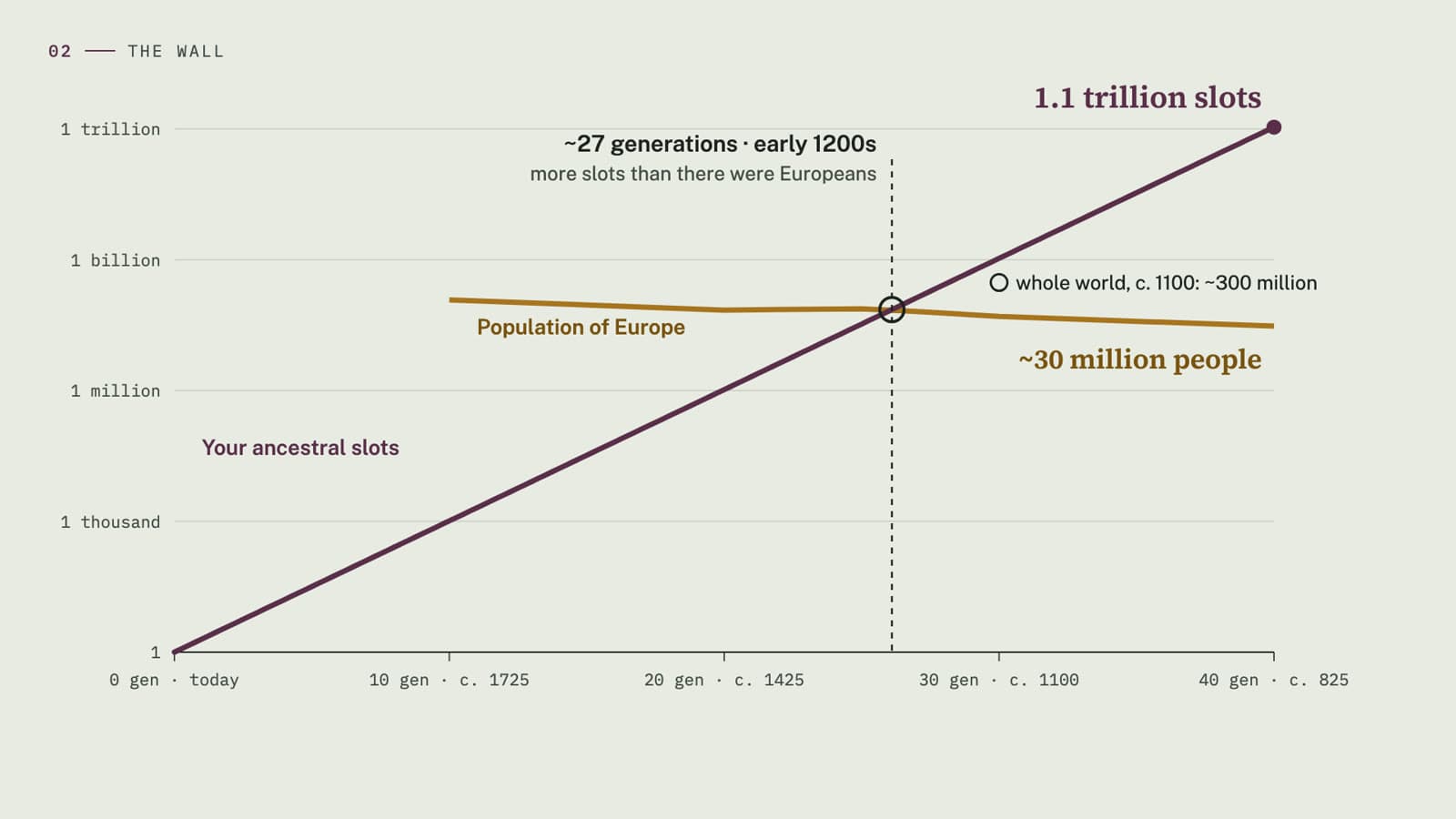
Two parents, four grandparents, eight great-grandparents: the slots in a family tree double every generation. Somewhere around 27 generations back, in the early 1200s, they outnumber every person then alive in Europe. By 40 generations, around the time of Charlemagne, the doubling asks for more than a trillion ancestors from a continent of about 30 million. The full table is in How many ancestors do you actually have?
The tree folds in on itself
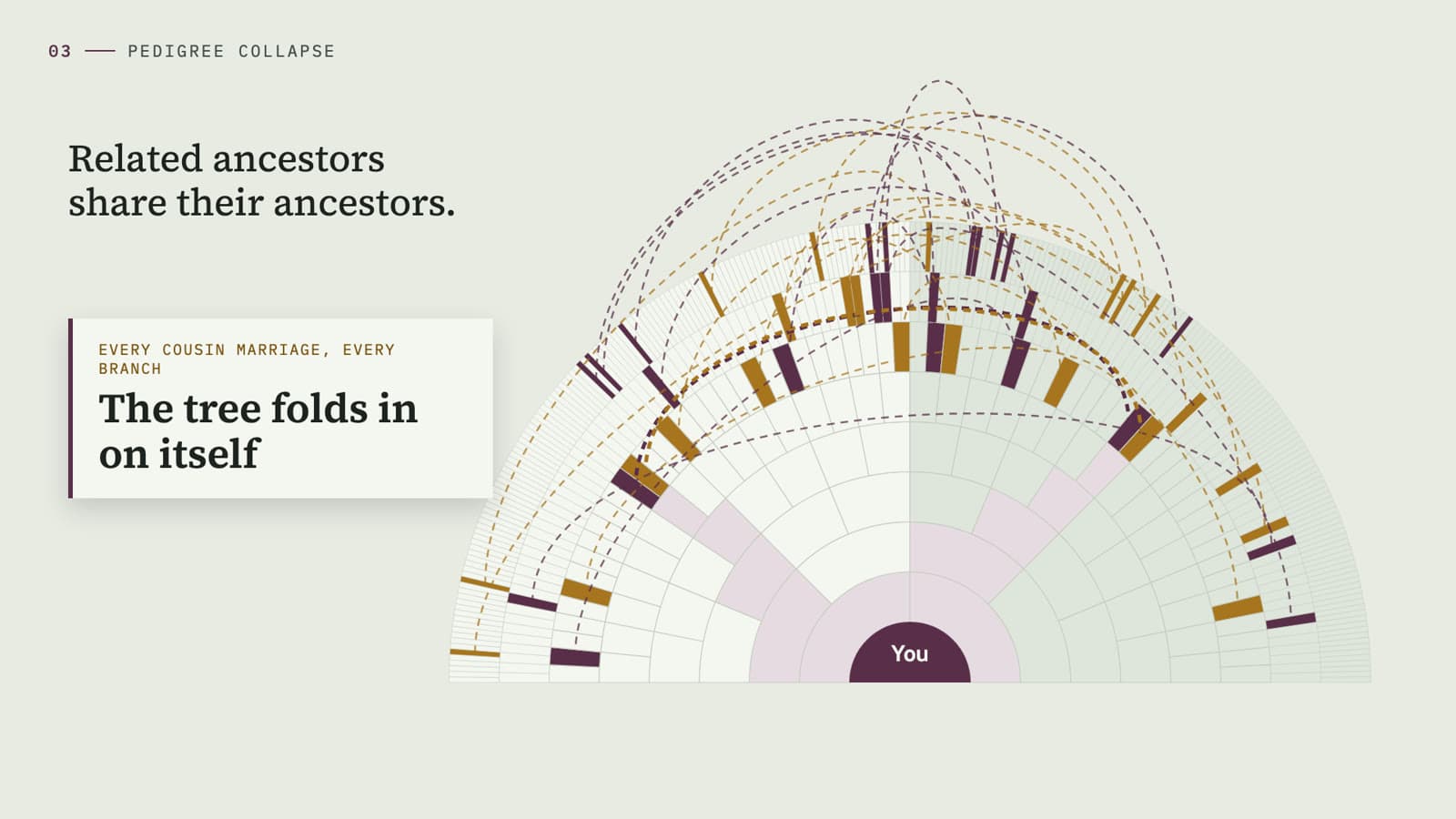
The slots are real, but the people filling them are not all different. If your parents were fourth cousins, one couple appears twice among your 64 fourth-great-grandparents: 64 slots, 62 people. Every cousin marriage in every branch does the same, and over 25 generations the tree folds back on itself.
Cousin marriage was everywhere. Bronze Age DNA from Crete shows about half of all marriages between first cousins; Classical Athens wrote it into law; Roman Egypt recorded brothers marrying sisters; and the medieval village married fourth and fifth cousins because there was no one else. Rome itself is the exception: legal, and mostly avoided. That story is told in Did ordinary Romans and Greeks marry their cousins?
Rise, peak, fall
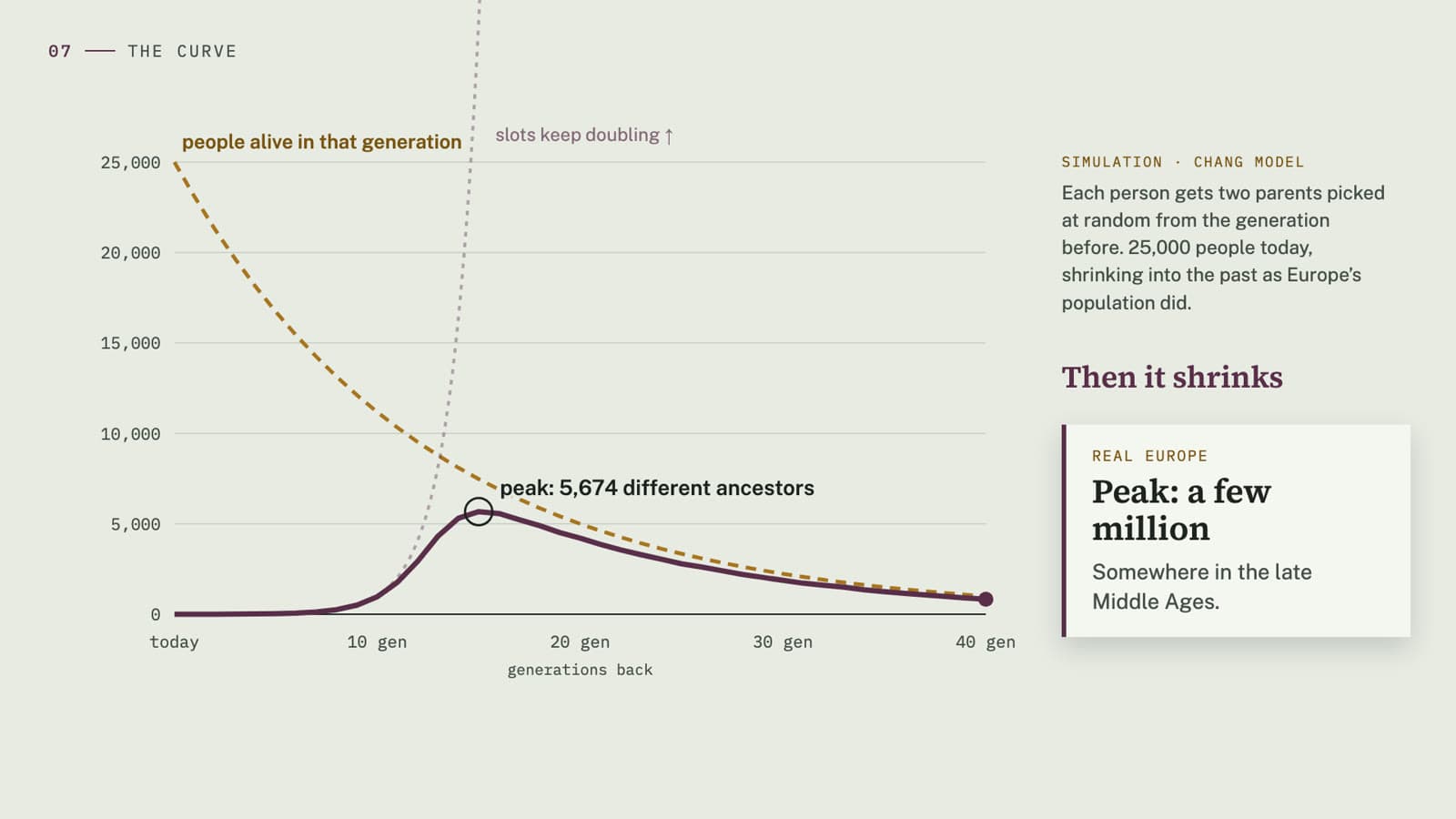
For the video we ran the simplest version of Joseph Chang’s 1999 model: each person gets two parents picked at random from the generation before, in a population that shrinks into the past as Europe’s did. The number of distinct ancestors doubles at first, bends, peaks, and then falls with the population itself.
Everyone or no one
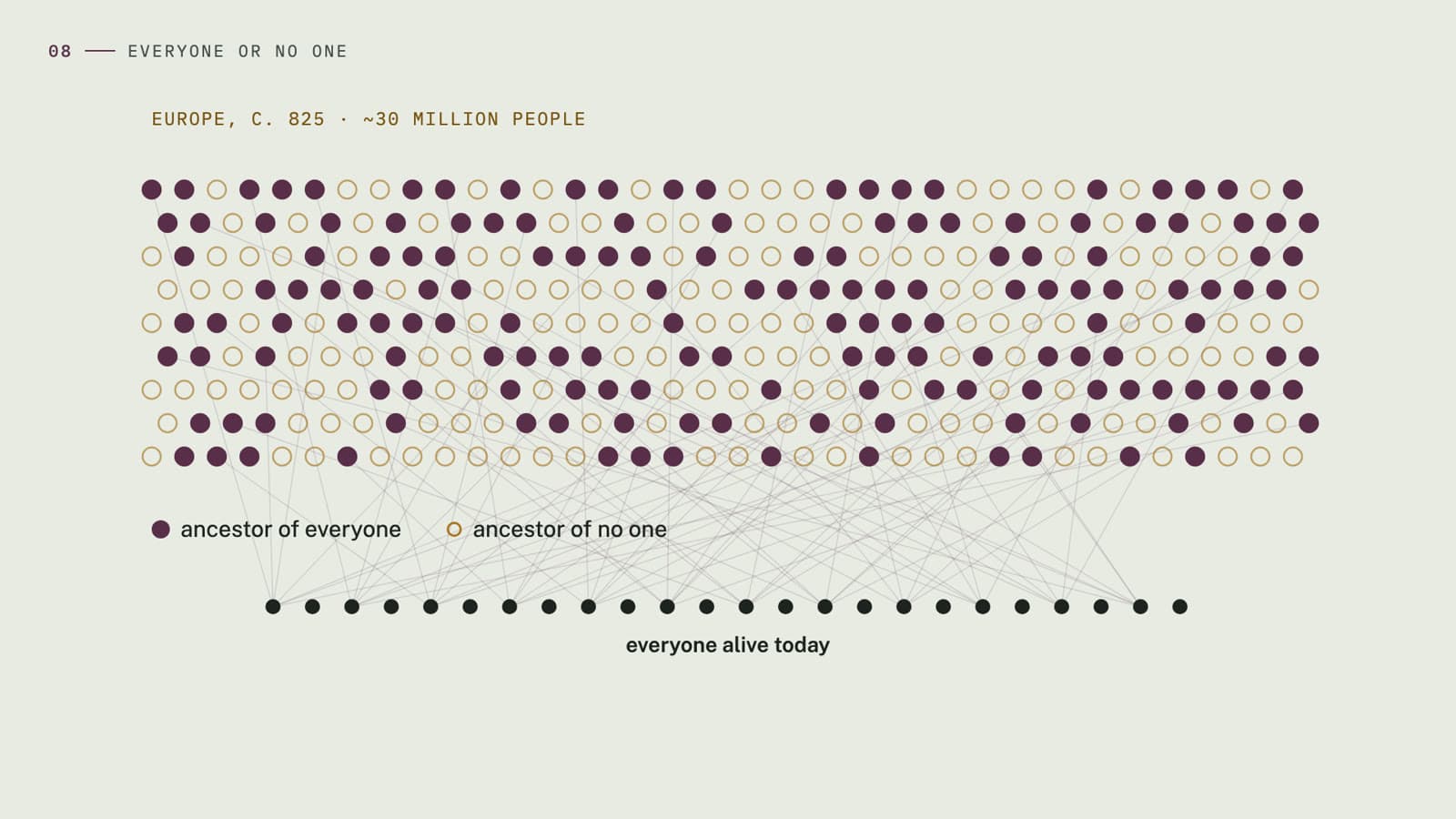
Go far enough back and the population splits in two. About half of the Europeans alive around 825 left no living descendants. The rest are ancestors of every European alive today, which is why almost everyone with European roots descends from Charlemagne. Proving any of it name by name is another matter: see Are you descended from ancient Rome?
More videos are on our YouTube channel.
Sources
- Chang, J. T. (1999). “Recent common ancestors of all present-day individuals.” Advances in Applied Probability 31(4): 1002–1026.
- Rohde, D. L. T., Olson, S., and Chang, J. T. (2004). “Modelling the recent common ancestry of all living humans.” Nature 431: 562–566.
- Skourtanioti, E. et al. (2023). “Ancient DNA reveals admixture history and endogamy in the prehistoric Aegean.” Nature Ecology & Evolution 7: 290–303.
- Shaw, B. D. and Saller, R. P. (1984). “Close-Kin Marriage in Roman Society?” Man 19(3): 432–444.
- Hopkins, K. (1980). “Brother-Sister Marriage in Roman Egypt.” Comparative Studies in Society and History 22(3): 303–354.
- Historical population figures for Europe are approximate (McEvedy and Jones, Atlas of World Population History).
Image credits
- Video thumbnail and stills from “Pedigree Collapse: Why You Don’t Have a Billion Ancestors”. White Glove Genealogy, Original.