Blog ·
Your Own AI Genealogist opens on 1 December
On 1 December the course opens: Your Own AI Genealogist, the method in seven videos. It teaches the way I research my own family, written down as rules that an AI assistant inside Claude Code has to follow every time, and it ends with one ancestor of your own researched to the professional standard. The free first video is on the home page and below, and if you leave your email there I will write to you the day the course opens.
Why I made it
Most people cannot name their great-great-grandparents, and most of the ones who can got the names from someone else’s tree and never saw a record. When I went back through my own first weeks of research and checked every note against the finished work, I found twenty facts that were wrong. Not one of them was invented. Every one came from somewhere real: an online tree, an index with a typo, a historian’s book applied to the wrong list, or a real record that someone, sometimes me, turned into a fact it does not say. An invented source is easy to catch. A real one, misread, is not.
AI assistants make this worse, not better, unless they are held to a standard. Ask a chatbot for your ancestor’s story and it writes a plausible one. The course is built on the opposite rule, and it is the one rule to remember: a fact without a source is a lead, not a finding.
What the course is
Seven videos, a couple of hours in all. You install the method, start your family from the names you already know, and research one ancestor end to end while I research one of mine beside you. My subjects are Geneviève Bettemont, a fourteen-year-old deported from Paris to Louisiana in 1719 who died a plantation owner, and her son Antoine Le Borne, a private in the German Coast militia. Every record in their line is free online, so you can follow every step without a subscription.
| # | Video | Length |
|---|---|---|
| 0 | Why your AI invents ancestors | free, on YouTube |
| 1 | Install and start | about 15 min |
| 2 | Plan and search | about 25 min |
| 3 | Capture and vet | about 30 min |
| 3a | Writing to an archive | about 10 min |
| 3b | Snail mail and paid orders | about 10 min |
| 4 | Write it up and build your family map | about 20 min |
The method is the Genealogical Proof Standard, which genealogists settled on long before there were computers: a reasonably exhaustive search, complete citations, analysis of the evidence, resolution of anything that conflicts, and a written conclusion. The course turns those five parts into rules the software must follow whether or not it feels like it, and shows you what each one looks like on a real record.
What you finish with
For one ancestor of your own, in a folder on your own computer:
- A research plan. The question, what is already known and sourced, and the record sets to check, in order.
- A search log. Every search, including the ones that found nothing, so the work is never repeated and the search can be shown to be exhaustive.
- Every record, with its citation. The image saved, a note on what it says and whose it is, and a citation that anyone can follow back to the archive.
- A written conclusion. What the records prove, what they only suggest, and what is still open.
- Your family map, online. A page of your own, built from your tree by the same tool: the story of your family chapter by chapter, with the famines, wars and migrations that moved them, every birth, death and move on a map, and the tree itself. We host it at yourname.whiteglovegenealogy.com, free for 90 days and then $50 a year, with sign-in for the family.
The map is the part people ask about. It is a page built from your tree by the same tool: your family’s story chapter by chapter, with the famines, wars and migrations that moved them, every birth, death and move on a map, and the tree itself. There is a demo map on the site, built from an invented family so that no one in it is real. Press “Tell the story” and watch it cross the Atlantic.
What you need
A computer, Claude Code, The names of your parents and grandparents. Nothing else to start. The records used in the course are all free online. Your own family may lead you to a paid site such as Ancestry, or an archive that charges for a copy; the method tells you when, and only when, that is worth it. If you already have a tree, you bring it in and the method starts checking it. If you have nothing yet, you start clean and never have to unlearn anything.
When, and how much
The course opens on 1 December 2026. It costs less than one hour of a professional genealogist, and you keep the method. The launch price is $69 for the first 50 students, then $99.
Until then: watch the free video, which shows the method catching two mistakes in my own tree in half a minute each, and leave your email so you hear the day it opens. Nothing else is sent to that address.
Sources
- Board for Certification of Genealogists, Genealogy Standards, 2nd ed. (Nashville: Ancestry, 2019): the Genealogical Proof Standard.
- Elizabeth Shown Mills, Evidence Explained: Citing History Sources from Artifacts to Cyberspace, 3rd ed. (Baltimore: Genealogical Publishing Co., 2015): the citation style the method uses.
- The Geneviève Bettemont and Antoine Le Borne research is written up in When the records burned and The man with no baptism.
Image credits
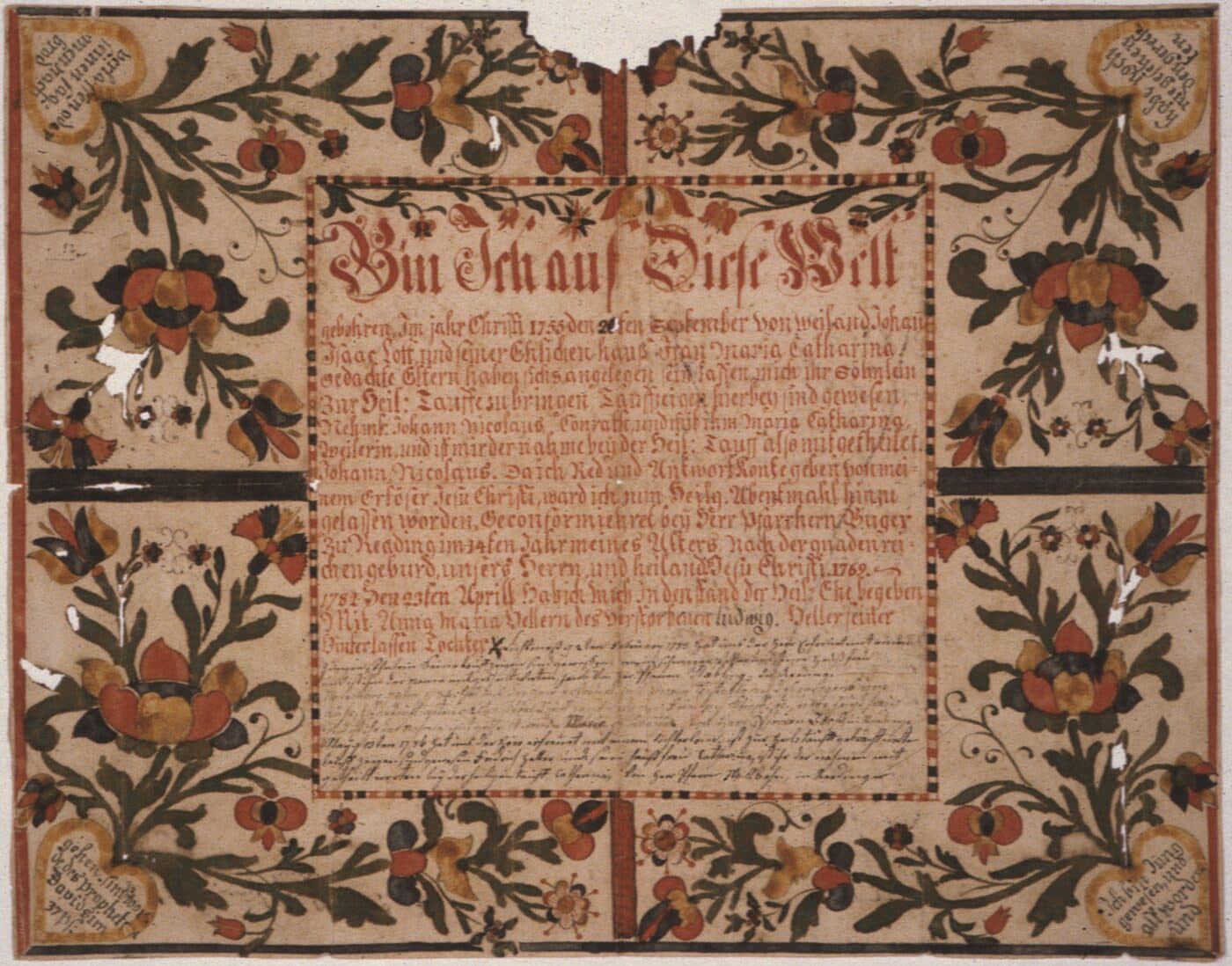
- Illustrated family record (Fraktur) found in a Revolutionary War pension and bounty-land warrant application file. U.S. National Archives and Records Administration (NARA 300199), via Wikimedia Commons, Public domain.
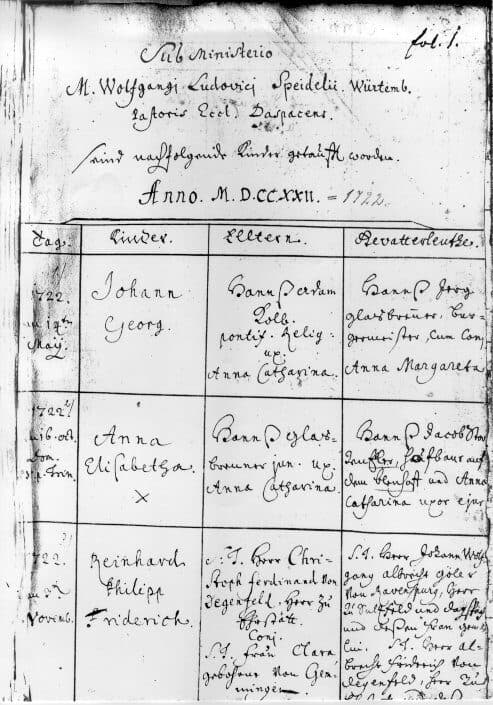
- Church book (Kirchenbuch), baptisms, 1722. Wikimedia Commons, Public domain.
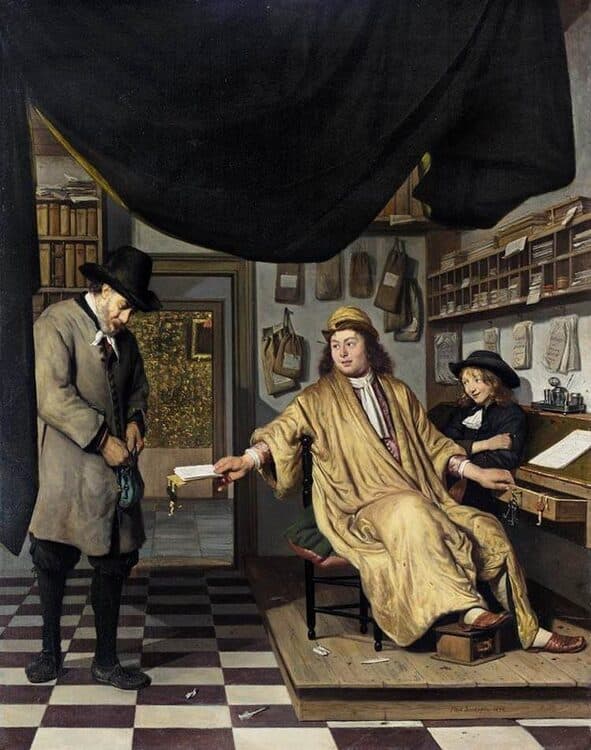
- Job Berckheyde, A Notary in His Office (1672). Web Gallery of Art, via Wikimedia Commons, Public domain.
- Chapman Bros., Family Record (blank), lithograph, Chicago, 1888. Library of Congress, Prints and Photographs Division, via Wikimedia Commons, Public domain.